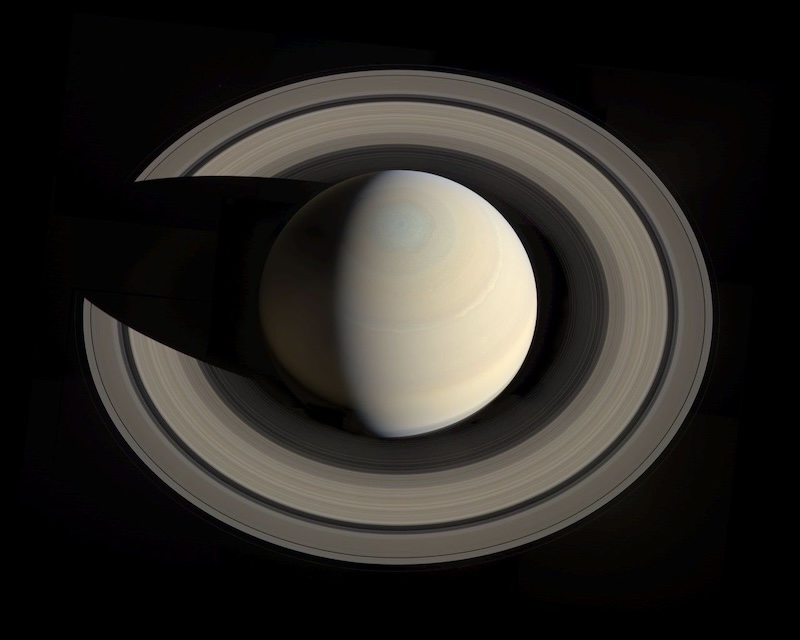
How to see Saturn
The best time of years to view our solar system’s 6th planet – the glorious planet of the rings, Saturn – is here. In mid-August 2026, Saturn is rising in the middle of the night. So by midnight you’ll find it ascending in the east, near the sunrise point of your sky. It’ll look like a bright, golden “star.” By dawn, Saturn will be at its highest in your sky.
Saturn is the most distant of the bright planets, those that are easily visible to the unaided eye. It’s also the faintest of the bright planets. You need a telescope to see Saturn’s rings. Nope, binoculars won’t reveal them (although binoculars might make the planet appear a bit more oval in shape to you than it does with the eye). But Saturn is also fun to watch with the eye alone. You’ll find it shining with a steady light, in a creamy golden color.
Saturn takes almost 30 years to orbit the sun. So it moves more slowly than the other bright planets in front of the fixed stars. The ancient Assyrians called Saturn Lubad-sag-uš, often translated as the oldest of the old sheep. It’s easy to imagine why, if you consider Saturn’s slow movement in front of the stars. Because of its nearly 30-year orbit, it takes nearly 30 years to complete one journey across our sky, traveling through all the constellations of the zodiac.
In contrast to the other bright planets, which move more noticeably in our sky, in front of the fixed stars, Saturn really does seem to amble like an old sheep.
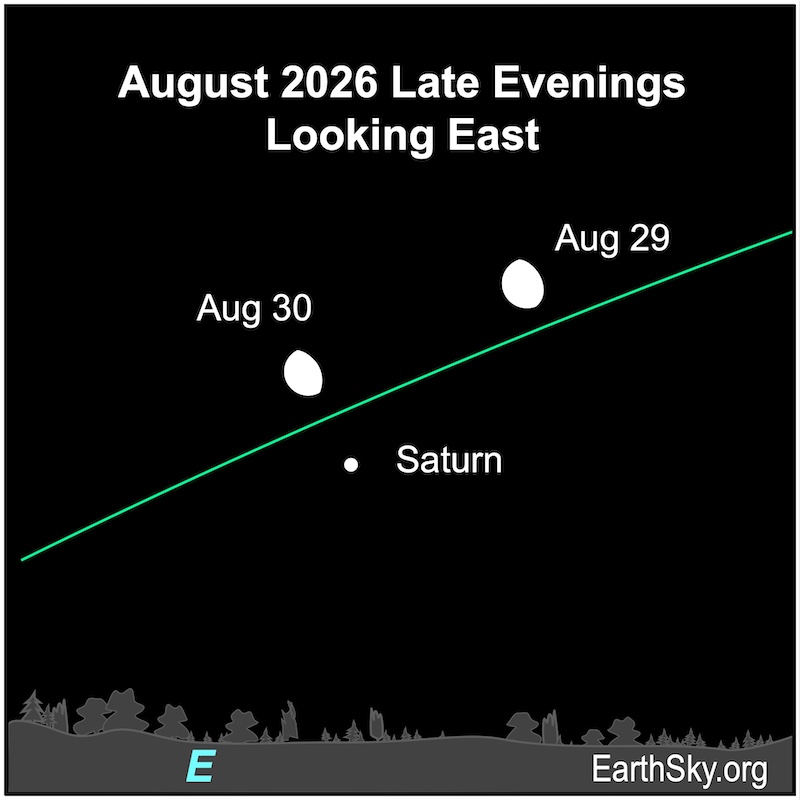
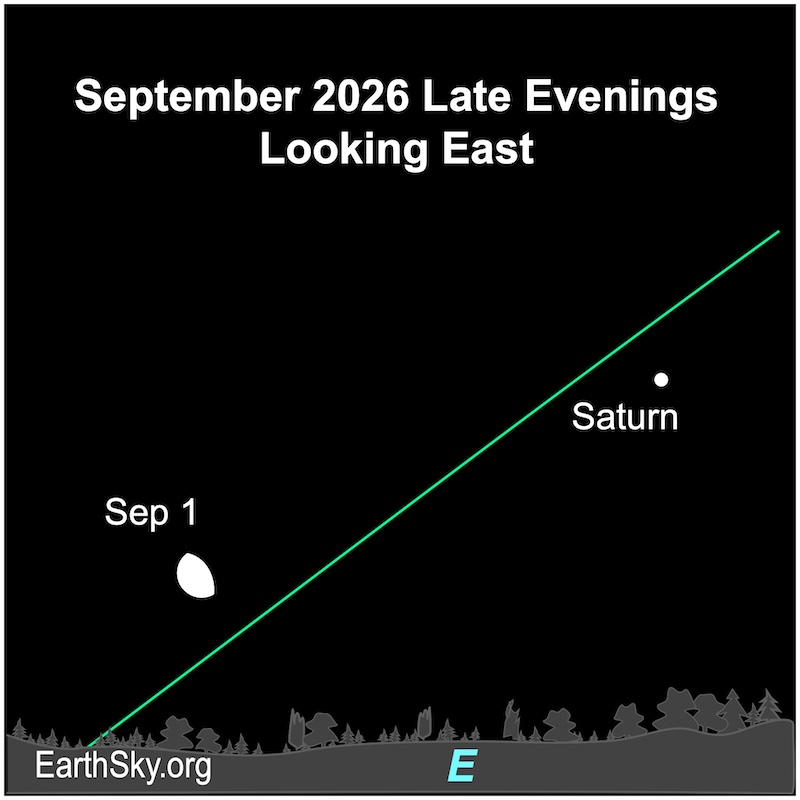
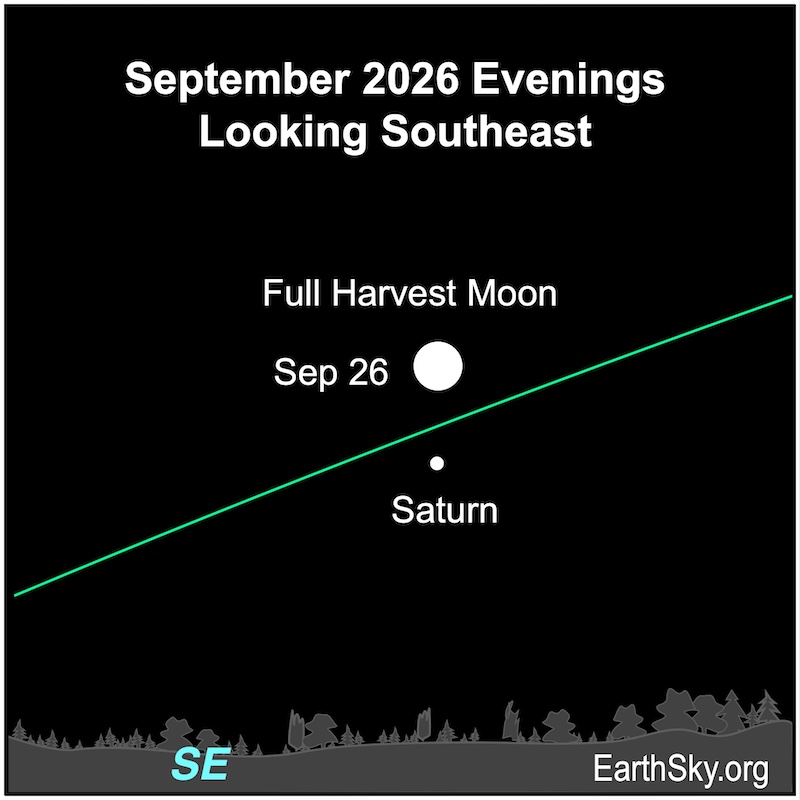
Saturn isn’t showy to the eye alone. It’s the hardest bright planet to recognize. But the moon is a handy tool. Look for Saturn near the moon on August 29 and 30, 2026. And it’ll be near the full moon again on September 27, and every month it is visible. To find Saturn near the moon every month of the year (except when it is behind the sun), visit EarthSky’s night sky guide.
Keep reading to learn the best time of 2026 to look for the golden planet.
Saturn finder charts
Saturn closest, brightest and opposite the sun
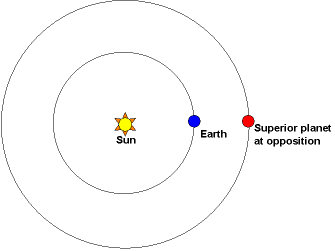
The best time of year to see an outer planet, like Saturn, are the months around that planet’s yearly opposition. That’s when Earth is between the sun and that outer world. The planet appears opposite the sun in our sky, rising into view at a convenient hour for viewing.
In 2026, Saturn will come to opposition on October 4. So the months around October are best for viewing the planet this year.
Because we’re going between Saturn and the sun then, October 4 will feature the ringed planet approximately at its closest to Earth. Because it’s closest, it’ll appear at its brightest in our sky. Saturn is the faintest of the bright planets. It’s still pretty bright, but, normally, you wouldn’t pick it out from among the stars.
But around September, October and November, you can view Saturn fairly easily, because Saturn will appear as bright as the brightest stars.
Since we pass Saturn – the 6th planet outward from the sun – from an inside track around the sun, the ringed planet will look as if it’s going backward (retrograde) for a time, in front of the fixed stars of the zodiac. In 2026, Saturn retrogrades from July 27 until December 11. That’s when it moves westward in front of the stars, in contrast to its regular motion, toward the east in front of the stars.
When Saturn started its retrograde (westward) movement in front of the backdrop stars of the zodiac on July 27, it was among the stars of Aquarius the Water Bearer. By the end of Saturn’s retrograde on December 11, it’ll lie among the stars of Cetus the Whale. It’ll remain in Cetus the rest of 2026.
Saturn’s yearly opposition happens about two weeks later with each passing year. The 2024 opposition happened on September 8. The 2025 opposition happened on September 21. And the 2026 opposition will be on October 4. And next year? Opposition for Saturn in 2027 will take place October 18.
So you see that Saturn – like most objects in the heavens – is really very orderly in its comings and goings in our sky. Once you learn to identify it, you can recognize it from year to year.
But how can you recognize it?
Like all planets, Saturn is lovely to gaze upon and think about. It’s a real place, after all, not just a light in the sky. Plus, Saturn’s brightness waxes and wanes in a subtle way throughout every year, making it fun to watch. But how can you recognize Saturn?
The best way is to start with the nights when the moon will be passing near. To find out when this will be: visit EarthSky’s night sky guide.
But what if you can’t wait for the moon? Here are some tips:
- Think about the path the sun travels across your sky. That path is called the ecliptic. On EarthSky charts, we nearly always represent that path by a green line. So – wherever you are on Earth – look along the sun’s path for Saturn.
- Look along that path for bright lights. Saturn may be the faintest of the bright planets, but it’s as bright as the brightest stars.
- Notice the twinkling of the stars. Stars twinkle because they are so far away. Through earthly telescopes, even, unless some special technique is being used, stars look like pinpoints. But Saturn is vastly closer than the stars. Through telescopes it looks like a golden (ring-encircled) disk. Light waves from one side of that disk cancel out light waves from the other side. So Saturn shines steadily!
- Watch for its golden color. Yes. Saturn appears golden to the eye. A golden, steady light – located along the sun’s path across the sky – is likely Saturn.
Can you see the rings of Saturn if you look with the eye alone? No, you need a small telescope. But Saturn is still beautiful to the eye. Once you learn to spot it, you’ll find a great source of contentment in recognizing it year after year.
Saturn from the Southern Hemisphere
Via Daniel Gaussen, Founder & Guide – Stargaze Mackenzie – Twizel, New Zealand
From the Northern Hemisphere, the sun’s path arcs across the southern sky. But, from the Southern Hemisphere, you will look north rather than south to follow the sun and planets along the ecliptic. How high the sun’s path appears to you depends on your latitude and on which part of the ecliptic you’re looking toward.
From Twizel, New Zealand, at about 44 degrees south latitude, different parts of the ecliptic can reach anywhere from about 23 degrees to nearly 70 degrees above the northern horizon as they cross the meridian. Farther north, from Auckland or much of Australia, parts of the ecliptic can climb higher still.
As Saturn spends nearly 30 years moving around our sky, it gradually passes through sections of the ecliptic that appear higher or lower in our sky. At its 2026 opposition, Saturn will reach about 44 degrees high from Twizel, 51 degrees from Auckland and 54 degrees from Sydney, comfortably above the horizon and offering good views through a telescope.
So, for much of the Southern Hemisphere, Saturn will be reasonably high above the northern horizon around its October 2026 opposition. It will rise around sunset in the east-northeast, climb across the northern sky and culminate (reach its highest point) due north around midnight, before heading toward the west-northwest.
Over the decades, Saturn’s altitude at opposition gradually changes as it makes its long journey through the zodiac, a planetary cycle you can watch unfold over a lifetime.
Where will Saturn be in the last few months of 2026?
Saturn is nearly always somewhere in our sky, for most of every year. In the second half 2026, as Earth moves away from Saturn in its orbit, we’ll see Saturn shift its location in our evening sky, rising earlier each night.
After Saturn’s opposition in October 2026, Saturn will appear farther to the west as darkness falls each month thereafter.
Finally, in March of 2027, Saturn will disappear in the western twilight after sunset.
One last thing, for you telescope users: the south side of Saturn’s rings are facing in Earth’s direction. They’ll have a -7.5-degree tilt around opposition.

Bottom line: We’re now in the best months for viewing Saturn in 2026. It’ll be at it’s best around October 4 when it’s closest to Earth and visible all night.
Read more: Why do stars twinkle, but planets don’t?
Read more: What is the zodiac? Why is it important in astronomy?
Like what you read?
Subscribe and receive daily news delivered to your inbox.
More from
Editors of EarthSky


Venus brightest in the evening sky this week

See Venus in the daytime: Here are 3 tips
Crepuscular rays are sunrays in twilight skies
What is retrograde motion? And why is the moon moving backwards?