



Twilight is that magical time of day when a glow pervades the air, even though the sun is below the horizon. Earth’s atmosphere scatters the sun’s rays to create the colors of twilight. On worlds with no atmospheres, such as the moon, the sky falls instantly dark after the sun sets.
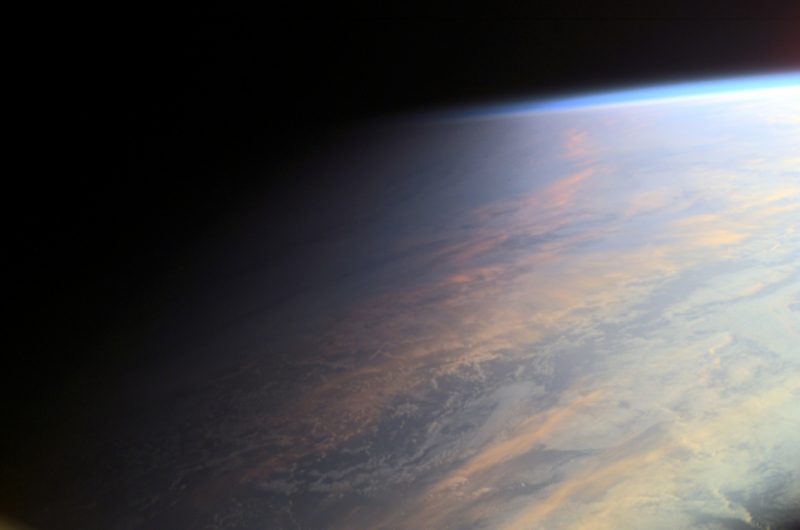
And, if you could see twilight from outer space, you’d find that it isn’t marked by a sharp boundary on Earth’s surface. Instead, the shadow line on Earth – sometimes called the terminator line – is spread over a fairly wide area on the surface and shows the gradual transition to darkness we all experience as night falls.
Astronomers – those experts on nighttime – recognize three stages of twilight. Keep reading or watch a video to hear about the intricacies of civil, nautical and astronomical twilight, below.
Stage 1: Civil twilight
Let’s consider the stages of twilight as occurring after sunset. Keep in mind that they would reverse their order at sunrise. Civil twilight begins the moment the sun slips below the horizon. The official definition of civil twilight is the time from when the sun disappears until the sun’s center is 6 degrees below the horizon. A measurement of 6 degrees of sky is a bit more than three fingers held at arm’s length.
During civil twilight, there’s enough light to see, but people turn on their lights to drive a car, and the streetlights are starting to come on. The brightest planets appear during civil twilight.
For mid latitudes, civil twilight lasts a bit longer in summer and winter and is a bit shorter in spring and fall. In spring and fall, the sun rises and sets more directly in the east and west. Therefore, it makes a straighter path downward (or upward), reaching the 6 degree mark in a shorter period of time. In summer and winter, the sun arcs across the sky, cutting across the horizon at an angle. This angle is more pronounced in summer, which is why civil twilight lasts the longest in summer. Civil twilight in mid latitudes can last, on average, 1/2 hour.
Compare this to tropical regions. At the equator, the length of civil twilight hardly varies. The sun around the equator makes a path across the sky that cuts cleanly down toward the horizon at sunset in a nearly perpendicular fashion. Therefore, the sun and its rays disappear faster, giving equatorial regions a shorter twilight than higher latitudes. Near the poles, twilight times last much longer.
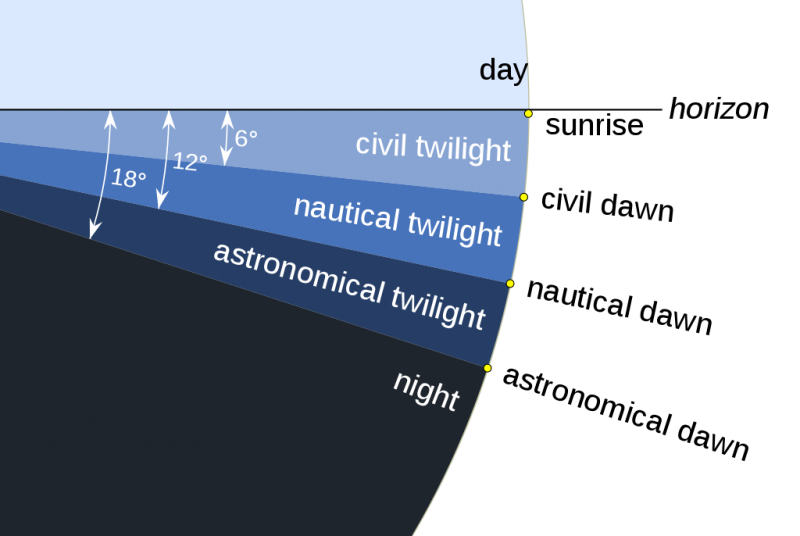
Stage 2: Nautical twilight
In the evening, nautical twilight takes over where civil twilight ends. The definition of nautical twilight is the time period when the center of the sun is 6 degrees below the horizon to 12 degrees below the horizon. You can remember the name “nautical” because it ends when the distant line between sea and sky is no longer distinguishable. Also, more bright stars appear during this time, which was important in the early days of navigation. When nautical twilight began, sailors could use the stars as directional cues.
During nautical twilight, terrestrial objects are visible, but you need artificial lights to carry on outdoor activities.
For polar regions, the summer sun does not get more than 12 degrees below the horizon. Therefore, these regions have nautical twilight all night long, never reaching astronomical twilight or total darkness. For mid latitudes, nautical twilight can last from about 1/2 hour in spring, winter and fall, to about 45 minutes in summer.
Stage 3: Astronomical twilight
The darkest twilight stage is astronomical twilight. The definition of astronomical twilight is the period of time when the center of the sun is 12 degrees below the horizon to 18 degrees below the horizon. You probably don’t even notice any illumination left in the sky at this time.
For stargazers, this is the time when fainter stars, clusters and other sky objects appear and become good observing targets.
In mid latitudes, astronomical twilight can last about 1/2 hour from fall through spring but up to an hour in summer. Astronomical twilight begins about an hour to 1 1/2 hours after sunset for mid latitudes. So, as a rule of thumb, if you’d like to observe something in the night sky that isn’t particularly bright, you should wait about 90 minutes after sunset before you start observing.
Twilight photo gallery

Bottom line: Twilight is that magical time between sunlight and darkness. Astronomers, the experts on nighttime, recognize three stages of twilight.
Like what you read?
Subscribe and receive daily news delivered to your inbox.
More from
Editors of EarthSky


Mercury is farthest from the sunset on June 15

Earliest sunrises come before the summer solstice
Celebrate World Oceans Day today, June 8, 2026


