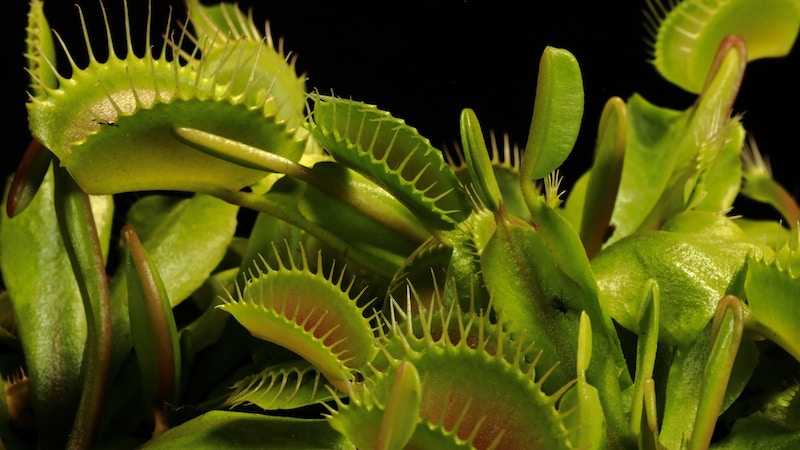
Few plants capture our imagination like the otherworldly Venus flytrap. Its snap-trap leaves clamp down on small insects in as fast as 1/10 of a second. That’s unexpected behavior among the staid plants we’re familiar with! Even now, scientists continue to learn new things about these enigmatic plants. For instance, how they know when to snap shut.
How does a Venus flytrap snap shut?
A Venus flytrap leaf has two lobes connected at a hinge on its stalk. Each lobe secretes nectar to attract insects. And cilia hairs line the edge of each lobe that will later seem like prison bars to some unfortunate prey.
The lobes curve out and stretch open, like a clam. Each inner lobe has three sensory hairs. When something bumps against those hairs that mechanical stimulus is converted into electrical signals in cells at the base of the hair. Those electrical signals then spread across the leaf.
An insect crawling on a lobe will most likely bump against the sensory hairs several times. But all it takes are two bumps within 20 seconds of each other for the lobes to clamp shut, imprisoning the prey.
How does a Venus flytrap keep track of time?
So, how does the Venus flytrap keep track of the time interval between these bumps? Scientists had long suspected that calcium ions were somehow involved.
This was definitively confirmed in October 2020. Researchers at the National Institute of Basic Biology in Okazaki, Japan, published a study in the peer-reviewed journal Nature Plants showing that changes in calcium concentrations inside leaf cells helped the plant keep time.
The researchers did this by genetically modifying Venus flytraps to emit green fluorescence when calcium ions were present in the leaf cells. When sensory hairs were first stimulated, the scientists were able to directly observe the increased concentration of calcium ions as a green glow. That concentration would gradually drop. Then, a second stimulus raised the calcium concentration again. When the calcium concentration reached a certain threshold, the trap snapped shut. But this required two stimuli occurring within 30 seconds to reach this threshold.
However, the two-bumps-within-30-second rule doesn’t always apply. Scientists at the University of Zürich in Switzerland showed that slow-moving animals, like insect larvae and snails, wind up in the Venus flytrap’s clutches.
What triggers it to shut?
Using precise micro-robots and sensitive sensors, they studied the amount and duration of force on sensory hairs that triggered a trap to shut. They used that data to create a mathematical model of how the plant reacted to stimuli from prey of different sizes. Their model showed a scenario – that they were later able to verify experimentally – where a single slow touch could create the two electrical signals needed to shut the trap. So, snails and caterpillars are just as likely to end up as a meal as fast-moving ants and flies.
Thanks for the opportunity ! My fav plant is the Venus fly trap ! ? pic.twitter.com/RNtak57nlw
— MechaFauna ? (@MechaFauna_) April 13, 2023
What happens when it captures an insect?
Once it captures an insect, the trap does not close completely. If the insect is small enough, it can still crawl out. That’s the plant’s way of ensuring that its prey is large enough to be worth the effort for the next stage: digestion. So, if the struggling bug is big enough, the leaf will then close even tighter around it and start releasing digestive liquids to break down the prey for absorption. If you’d like to learn more about it, check out this wonderful article by science writer Ed Yong in The Atlantic. There’s also a nice overview of Venus flytraps and how to grow them at the Botanical Society of America website.
Dionaea muscipula, the Venus flytrap, is a rare plant in the wild, found only in the coastal bogs of North Carolina and South Carolina. They’re increasingly hard to find and have been proposed for listing as an endangered species. But currently they are only a threatened species and protected by state law in North Carolina. The biggest problem they face is habitat loss. And it’s not just from development, but also from a lack of forest fires that they need to clear out competing plants. Plant poaching is also a major reason for their decline in the wild. If you want to grow a Venus flytrap, you can easily find one at a reputable nursery.
Why do Venus flytraps go after small insects?
Like other carnivorous plants, the evolution of Venus flytraps in nutrient-poor habitats led to a unique adaptation. It enabled them to trap live animals for additional sustenance. A few other carnivorous plants have developed movements to trap live food, like the waterwheel. But none of them have the dramatic trapping effect of the Venus flytrap, which inspired Audrey II, the star of “Little Shop of Horrors.”
Bottom line: Venus flytraps have small sensory hairs in their leaf lobes that alert them to potential prey. This causes the snap-trap lobes to dramatically clamp down on small insects and spiders.
Source: Calcium dynamics during trap closure visualized in transgenic Venus flytrap
Like what you read?
Subscribe and receive daily news delivered to your inbox.
More from
Shireen Gonzaga


Interstellar comet 3I/ATLAS born in a cold environment

Black hole Cygnus X-1 has fast, powerful dancing jets