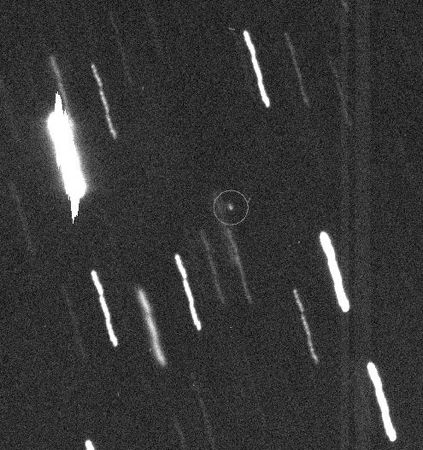
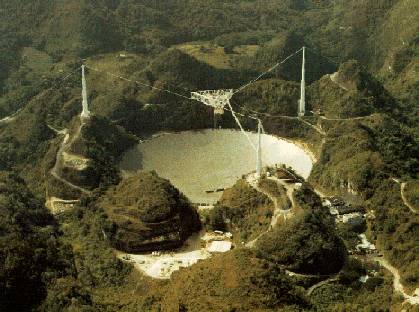
Astronomers are gearing up to observe asteroid Apophis, which will come to within 0.1 A.U. (14,450,000 kilometers; 8,980,000 miles) of Earth on Wednesday, January 9, 2013, and which will come close again in subsequent years with an extremely remote possibility of striking Earth in 2036. In late 2012 and early 2013, Apophis has been observable using both optical and radar equipment. The data collected around now are expected to make possible a significant improvement in our understanding of the orbit of Apophis and remove any possibility for an Earth impact on April 13, 2036. However, as David Helfand of Columbia said when EarthSky interviewed him in 2010 on killer asteroids, the risk from Apophis is already essentially zero.
What does essentially zero mean exactly? Let’s review some history. When Apophis was discovered in 2004, astronomers calculated that there was a very small probability (up to 2.7%) that it would strike the Earth in 2029. That was clearly unsettling, but the concern was short-lived. The 2029 impact possibility was quickly ruled out, but, almost as quickly, another possibility reared its head: a possible impact in 2036. For a time, astronomers thought there was a 1-in-45,000 chance that Apophis would strike Earth on April 13, 2036. Then, in October 2009, the numbers were updated again, and the impact possibility decreased again. Currently, the chance of an impact with Earth by asteroid Apophis in 2036 has dropped to about 1-in-250,000. While greater than your chance of winning a lottery (many millions to one), it’s still very very unlikely. That’s the number David Helfand calls essentially zero. Astronomers believe the possibility will drop to absolutely zero after the early 2013 pass by Apophis.
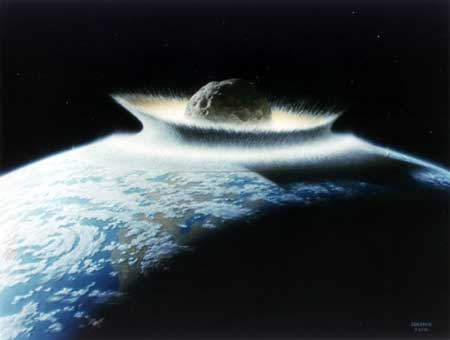
What would happen if Apophis did strike Earth? Researchers say it would cause an explosion 100,000 times more powerful than the nuclear weapon detonated over Hiroshima.
Still, Apophis is more a curiosity than a threat, at this point. As things stand today, ignoring the new orbit calculations in the coming months (which might change everything I say next), astronomers speak of a 600-meter-wide keyhole through which Apophis would have to pass in 2029, in order to be on a collision course with Earth in 2036. When you work in astronomy, and have some concept of how vast space is, that keyhole seems almost ridiculously small. EarthSky spoke to Don Yeomans, who is manager of NASA’s Near Earth Object Program. Speaking of the Apophis pass in 2029, he said that, yes, it will come close:
In fact, it will get beneath the geosynchronous satellites [which are 26,000 miles up], the same satellites that are probably used to beam your radio signals to your listeners. So that’s kind of exciting. But it won’t hit the Earth.
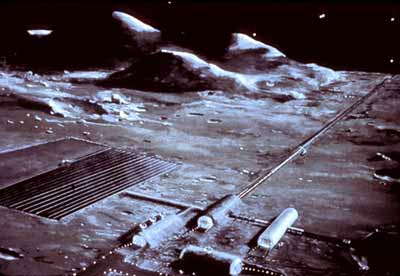
Yeomans also said that, in the very remote case where the impact probability does not go to zero as 2036 approaches – if the asteroid does seem that it will come too close for comfort – there still would be time to send spacecraft to Apophis and deflect away from Earth.
Astronomers have been meeting periodically since the 1990s on ways to deflect asteroids, should they come too close. The ways include sending nuclear weapons to explode on them or near them – putting up a satellite that gravitationally tugs at the asteroid a little bit, so its orbit changes ever so slightly just enough to miss the Earth – or outfitting the asteroid with a mass driver that would eject material from the asteroid into space, decreasing its mass and thereby changing its orbit.
There are more asteroid collision avoidance strategies, which you can read about on Wikipedia. So scientists are, indeed, contemplating the physics and engineering challenges of keeping us safe from asteroid collisions.
By the way, in February 2011, Asteroid Apophis was back in the news, this time due to the release of a report by Russian scientists, which the Huffington Post chose to present in pairing with a scary, factually incorrect and very misleading video. When I looked just now, the story was still there, but the video didn’t come up so maybe they removed it. Don Yeomans commented:
The Huffington Post video was creepy and all wrong.
Still, if you happened to see that video in February 2011 on HuffPo or elsewhere, don’t believe it. Asteroid Apophis is not on a sure collision course with Earth in 2036, but astronomers do have their eyes on this object, and – if a too-close pass seems imminent – we’ll have time for a deflection via spacecraft.
Bottom line: At present, there is a 1-in-250,000 chance that asteroid Apophis will strike Earth in 2036. That very remote chance is expected to drop to zero after the early 2013 pass of Apophis near Earth, which will occur on January 9.
Like what you read?
Subscribe and receive daily news delivered to your inbox.
More from
Deborah Byrd


Summer Triangle: Star pattern of the season