



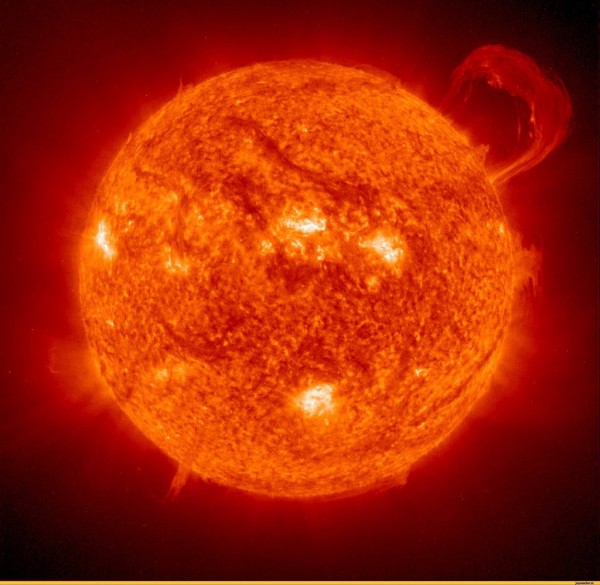
Although it’s a star – and our local star at that – our sun doesn’t have a generally accepted and unique proper name in English. We English speakers always just call it the sun.
You sometimes hear English-speakers use the name Sol for our sun. If you ask in a public forum like this one, you’ll find many who swear the sun’s proper name is Sol. But, in English, in modern times, Sol is more a poetic name than an official one. You’ll never see Sol used by astronomers in their scientific writings, for example, unless they are writing in Spanish, Portuguese, or Swedish where sol translates as sun.
Solis is Latin for sun. Sol is the Roman equivalent of the Greek sun god Helios. And maybe in earlier times English-speakers did use these names. According to straightdope.com, the first cited use of Sol as a proper name for the sun is the 1450 Ashmole Manuscript Treatise on Astrology, which stated:
Sol is hote & dry but not as mars is.
The International Astronomical Union (IAU) is the international body of astronomers that, since 1922, has given itself the responsibility for naming celestial bodies. And the IAU does recognize official names for the major planets (Mercury, Venus, Earth, Mars, Jupiter, Saturn, Uranus, and Neptune) and Earth’s satellite (Moon). It also officially names dwarf planets such as Pluto and Ceres, moons of planets, minor planets (asteroids), comets and – beyond our solar system – distant stars, the exoplanets that orbit them, and vast nebulae, galaxies and other objects.
But, to my knowledge, the IAU has never officially sanctioned a name for our sun.
Just to confuse things, though, the IAU suggests we all use Sun and Moon, rather than the lowercase sun and moon. As a result, most astronomers do capitalize these words (frequently along with other non-standard capitalizations such as Galaxy, Solar System and Universe), but most media organizations (which tend to use media stylebooks such as the AP Stylebook) don’t.

So people don’t agree on whether the sun has its own name, or what that name might be. Meanwhile, the sun does have a symbol that’s exclusively its own. The sun’s symbol is a circle with a dot in the center – used in mathematical formulas.
If it is nameless, our sun has company. There are several thousand stars visible to the eye, and only a few hundred of them have actual names, as opposed to designations. Astronomers use the Greek alphabet to order visible stars in each constellation, according to their brightness. To identify stars invisible to the eye, astronomers turn to star catalogs, which assign a number to each star according to its position in the sky.
Nowadays, we know there are planets orbiting many if not most stars. Most extrasolar planets haven’t yet been given proper names either, although some have.
When all is said and done, whether you believe our sun has a name comes down to the language you speak, to whom you give the authority to name objects in space, and to your personal preference.
Enjoying EarthSky? Sign up for our free daily newsletter today!

Bottom line: The International Astronomical Union hasn’t sanctioned an official name for our sun, and our sun doesn’t have a generally accepted and unique proper name in the English language. But, in history and in other languages, the sun does have various proper names.
Like what you read?
Subscribe and receive daily news delivered to your inbox.
More from
Deborah Byrd


Summer Triangle: Star pattern of the season


