



This is the Northern Hemisphere’s polar jet stream. It’s a fast-moving belt of westerly winds that traverses the lower layers of the atmosphere, created by the convergence of cold air masses descending from the Arctic and rising warm air from the tropics. In early November 2025, this jet stream is dipping southward, bringing an Arctic air blast – with cold and snow – to much of the U.S. Video via NASA Goddard Scientific Visualization Studio.
An unusually strong polar airmass is moving into the United States. Meteorologist expect it to bring the first real shot of cold air so far this season for many across the country, from the U.S. Midwest out toward the U.S. East, and as far south as Texas. Freeze watches and warnings are in place for Oklahoma, Arkansas, Texas, Louisiana, Mississippi, Alabama and Georgia as cold air filters in Sunday and Monday, November 9 and 10, 2025. In addition to cold weather, snow and lake effect snow could total up to nearly a foot (.3 meter) for some around the Great Lakes.
Arctic air is spilling south from northern Canada thanks to a dip in the polar jet stream. The jet stream is a band of strong winds in the upper levels of the atmosphere, typically about 30,000 feet (9,000 meters) above the ground. When the jet stream dips south, the cold air spills south.
The jet stream, with this push of cold air, could go as far as the Deep South, which is why the freeze watches and warnings have been issued as far south as they are.
Note: Freeze watches and warnings are issued for agricultural reasons as freezes can kill or damage sensitive crops. Freeze advisories are typically issued in the fall and spring to help farmers and other crop producers protect their plants. Once a hard freeze has occurred, the growing season is considered finished, and freeze watches and warnings typically no longer go out until the following spring.
- Freeze watches are alerts for significant, widespread freezing temperatures are expected within the next 24 to 36 hours.
- Freeze warnings are for when temperatures are expected to fall below freezing for an extended period of time.
Read more from Weather.gov: Understanding Cold Weather Alerts.
Meanwhile, near the Great Lakes
Forecasts indicate that some communities near the Great Lakes will receive a significant snowfall anywhere from Sunday through Tuesday, depending on location. A “clipper” low pressure system is forecast to move northeast near the Great Lakes, bringing a quick burst of snow. But meteorologists expect lake effect snow to bring more for communities south of Lakes Michigan, Superior and Erie, as well as areas east of Lake Michigan.
Lake effect snow can be tricky to forecast at times, because the bands of snow are typically narrow and dependent on wind direction.
As it stands, the forecast calls for 7-10 inches (18-25 cm) from Chicago through northern Indiana, 6-12 inches (15-30 cm) for western Michigan, and 5-10 inches (13-25 cm) for the Upper Peninsula of Michigan south of Lake Superior. The exceptions are communities southeast of Marquette, Michigan, where 8-19 inches (20-48 cm) are expected.
All of these snowfall totals are through Tuesday night.


What is lake effect snow?
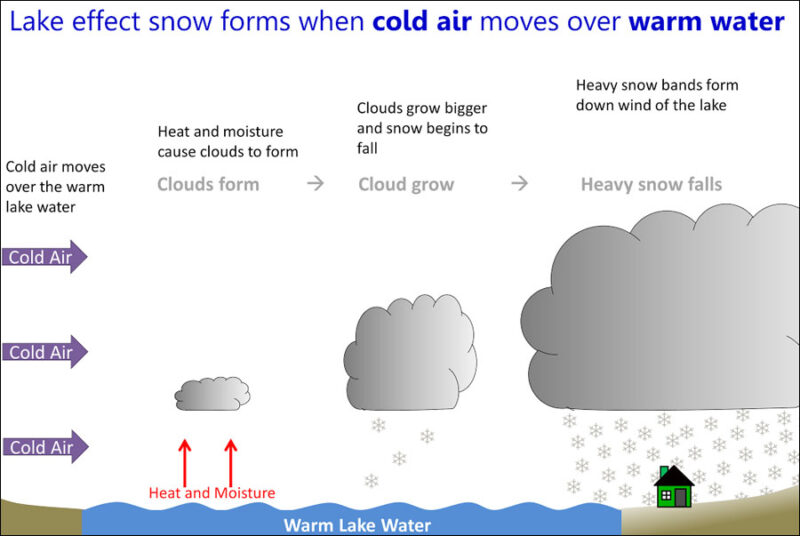
Lake effect snow occurs when cold air moves over warmer water, most often the Great Lakes. As the cold air moves over warm water, the warm water increases the temperature of the air due to something called latent heat release. The warm air then rises and eventually clouds develop. As the clouds continue to develop and precipitation forms, if the air is at or below freezing from the surface up to a few thousand feet up, the precipitation then develops into snow.
Lake effect snow often falls in narrow bands that can drop on average 2-3″ (5-8 cm) of snow per hour. But some lake effect bands can produce more than 3 inches (8 cm) of snow per hour.
The wind direction is crucial for lake effect as a slight shift in wind can shift the band of snow, leading to variability in snowfall totals. But a persistent, prevailing wind also directly plays into why communities under a snow band can easily see inches of snow in a short amount of time.
Time of year also plays an important role in the development of lake effect snow. Late fall and early winter – when lake waters are still relatively warm and not as much ice is covering the water – are more favorable for significant lake effect snow.
Arctic air blast to bring cold nights, chilly afternoons
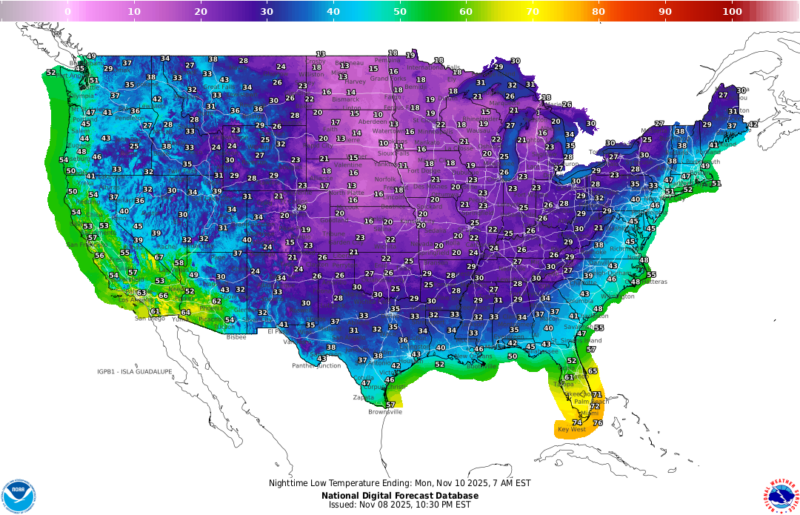
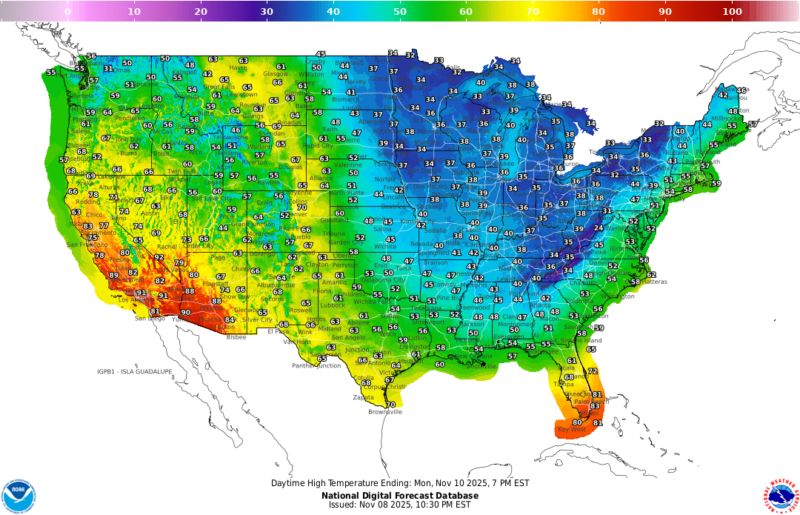
The Arctic air blast will bring the first real shot of cold temperatures for many across the United States. In fact, some areas have already been feeling the cold this weekend. Temperatures will likely be lowest Sunday night, and then Monday afternoon, although Tuesday morning will also be cold for many. Sunday night could have some in the Northern Plains experiencing temperatures in the teens, while Monday afternoon won’t warm up much with high temperatures for many staying in the 30s Fahrenheit (around 0 Celsius).
By Monday night and Tuesday morning the core of the cold air shifts east and south, with morning temperatures Tuesday falling into the 20s F (a few degrees below 0 C) in some places. The forecast comes from the National Weather Service.
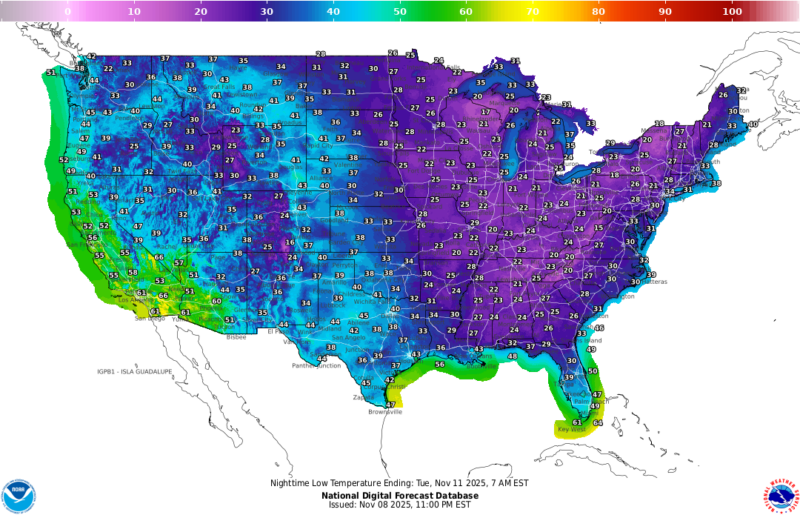
Bottom line: A dip in the jet stream will bring a significant Arctic air blast across much of the United States, including Oklahoma, Arkansas, Texas, Louisiana, Mississippi, Alabama and Georgia on Sunday and Monday. Snow and lake effect snow could total up to nearly a foot (.3 meter) for some around the Great Lakes.
Like what you read?
Subscribe and receive daily news delivered to your inbox.
More from
Rachel Duensing


Severe weather, tornadoes possible Sunday and Monday

What is a derecho? And when is derecho season?
Severe weather outbreak today for Midwest


