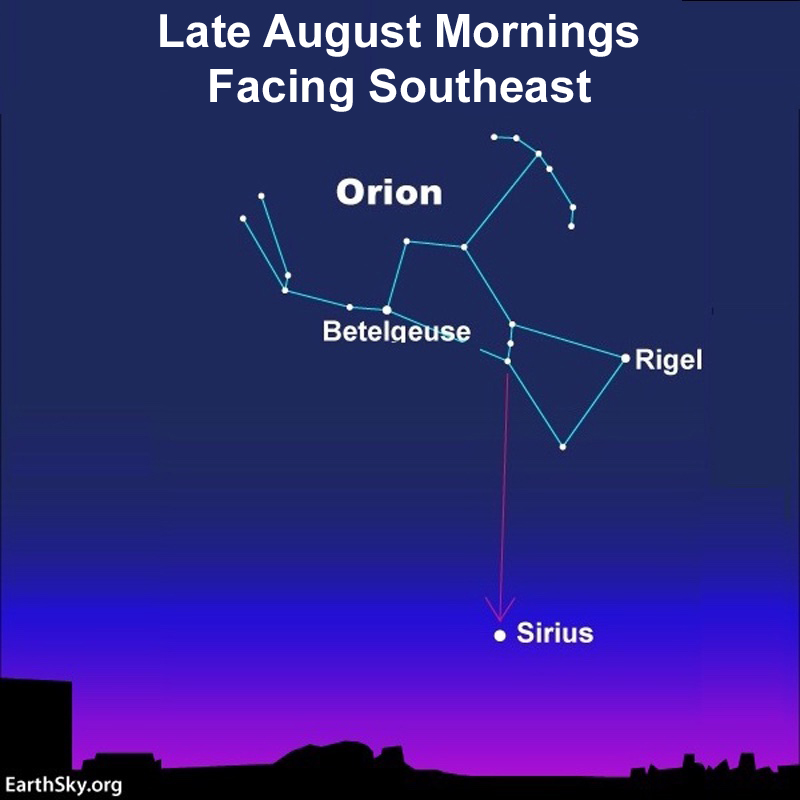
In late August and early September, look for two hints of the changing season in the predawn sky: Orion the Hunter and Sirius the Dog Star.
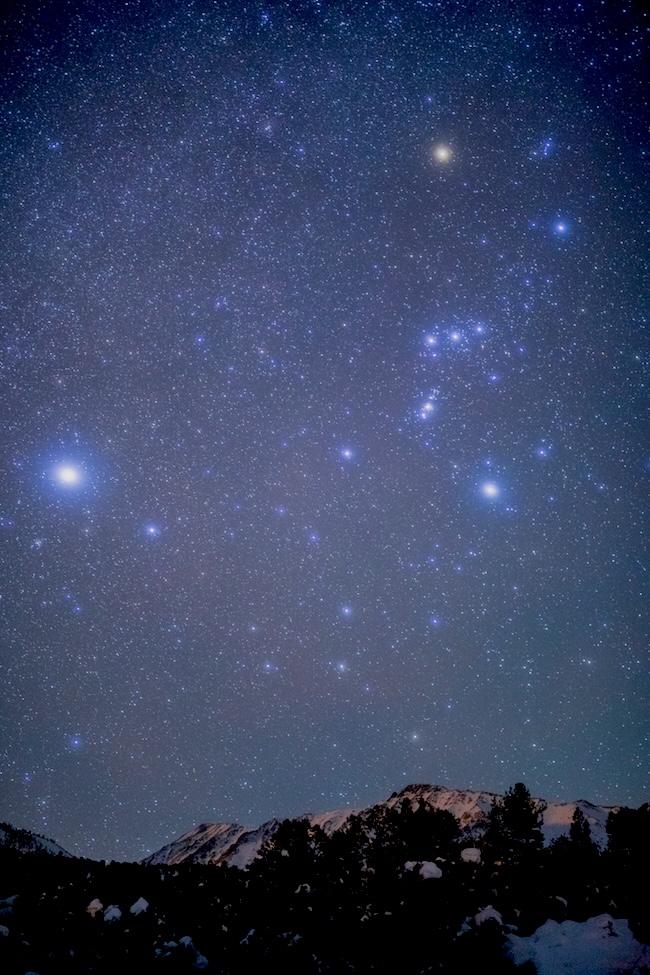
Orion is easily recognizable by the short straight line of three bright stars that make up his Belt. The constellation rises before dawn at this time of year. And the sky’s brightest star, Sirius – also known as the Dog Star, in the constellation Canis Major the Greater Dog – follows Orion into the sky as the predawn darkness gives way to dawn.
Have you noticed a very bright, madly twinkling star in this part of the early morning sky? Many do at this time of year. That star is Sirius. It’s so bright that, when it’s low in the sky, it shines with glints of red and flashes of blue. That’s the effect of our thick atmosphere causing its light to twinkle.
You won’t see Orion and Sirius in the evening sky until northern winter (or southern summer). But presently, the Hunter and the Dog Star lord over the sky at dawn.
Stars and constellations pass behind the sun
Orion was low in the west after sunset around March and April. By June of each year, the Hunter lies behind the sun as seen from Earth. Orion only returned to visibility in Earth’s sky about a month ago. Once a constellation becomes visible again, after being behind the sun, it always appears in the east before sunrise.
That’s because – as Earth moves around the sun – all stars rise two hours earlier with each passing month. So Orion is now higher at dawn than it was a month ago.
As seen from the Northern Hemisphere, Orion precedes Sirius into the sky. After Orion first appears at dawn, you can count on Sirius to appear in the morning sky a few weeks later.
The heliacal rising of Sirius
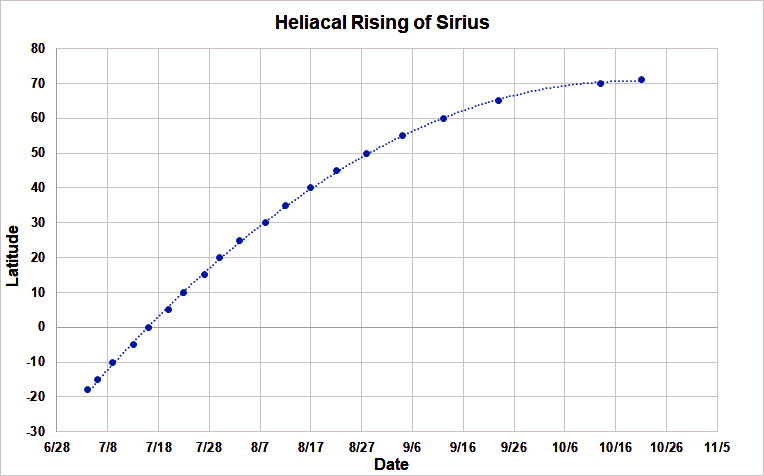
Now will be a good time to look for the heliacal rising of Sirius. In other words, what is the first date that you can see Sirius, with the unaided eye, in your morning sky? It depends on your latitude.
Below are a couple of graphs showing when you can expect to first see Sirius in your eastern predawn sky. They are designed for average eyesight, average weather and from near sea level.

The return of Sirius and the colors of the stars
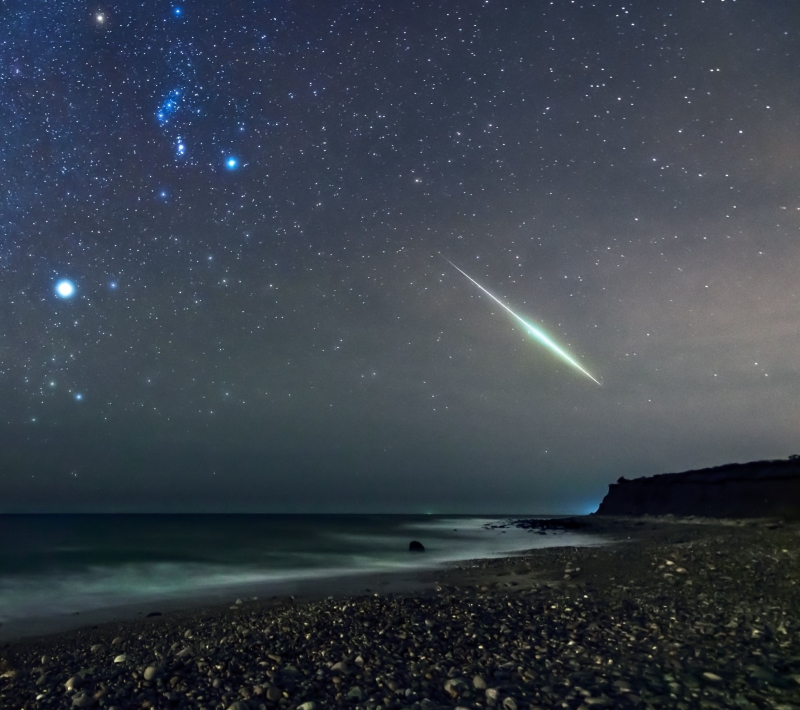
With Sirius and the stars of Orion low in your sky, you might notice that their light shimmers in various colors. But it’s not the stars that are changing; this is the prismatic effect of Earth’s atmosphere. As seen through a greater-than-usual thickness of atmosphere in the direction of the horizon, the mostly white light of Sirius can be broken up into striking colors on a summer morning.
But stars can be intrinsically colorful, too. Be sure to notice the reddish color of Betelgeuse when you watch Orion rise in these late summer months.
Bottom line: A sign of the changing season is the return of Sirius before sunup. Be the first from your latitude to see Sirius in the morning sky.
Read more: Is Sirius the most luminous star in the sky?
Help support EarthSky! Check out the EarthSky store for fun astronomy gifts and tools for all ages!
Like what you read?
Subscribe and receive daily news delivered to your inbox.
More from
Editors of EarthSky


Mercury is farthest from the sunset on October 12

We fly between the sun and Saturn. At opposition today
October birthstone: Colorful opal and tourmaline
Watch for the daytime moon after sunrise this week