



Image at top: Eta Aquariid meteors over the Atacama Desert in 2015, via Yuri Beletsky.
Before dawn these next several mornings – May 4, 5 and 6, 2020 – meteors from the annual Eta Aquariid meteor shower will be flying, though in the glaring light of the almost-full waxing gibbous moon. We expect the morning of May 5 to showcase the peak number of meteors. But try the mornings before and after as well, as this meteor shower has a relatively broad peak. The morning before (May 4, 2020) might be the best of these upcoming three days, because the moon will set at an earlier hour on May 4. Even so, you won’t have much moon-free viewing time before dawn on May 4.
Visit Sunset Sunrise Calendars to find out when the moon sets in your sky, remembering to check the moonrise and moonset box.
Although the shower can be seen from all parts of Earth, the Eta Aquariids are especially fine from Earth’s Southern Hemisphere, and from the more southerly latitudes in the Northern Hemisphere. Appreciably north of 40 degrees north latitude (the latitude of Denver, Colorado; Beijing, China; and Madrid, Spain), the meteors are few and far between. The reason has to do with the time of twilight and sunrise on the various parts of Earth. To learn more, check this post on why more Eta Aquariid meteors are visible in the Southern Hemisphere.
It also helps to know that – as seen from all parts of Earth – the dark hour before dawn typically presents the greatest number of Eta Aquariid meteors.
Want to know when morning dawn first starts to light up your sky? Visit Sunrise Sunset Calendars and check the astronomical twilight box.
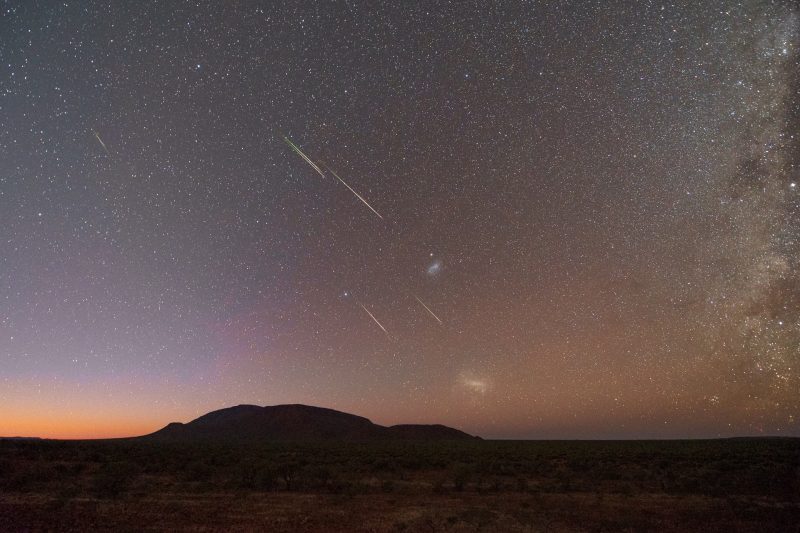
Like most meteors in annual showers, the Eta Aquariids are debris left behind by a comet, and, in this case, it’s a very famous comet indeed. Every year, as Earth passes through the orbital path of comet Halley, bit and pieces shed by this comet burn up in the Earth’s atmosphere as Eta Aquariid meteors.
May 6, 2017 – Eta Aquariid captured at Mount Bromo (4K timelapse) from Justin Ng Photo on Vimeo.
Under ideal conditions, the Eta Aquariid meteor shower produces up to 20 to 40 meteors per hour. This year – 2020 – the waxing gibbous moon will light up the sky most of the night, and you will probably see fewer meteors.
And, as always for meteor-watching, be sure to avoid city lights …
Visit EarthSky’s Best Places to Stargaze page to find dark sky locations near you
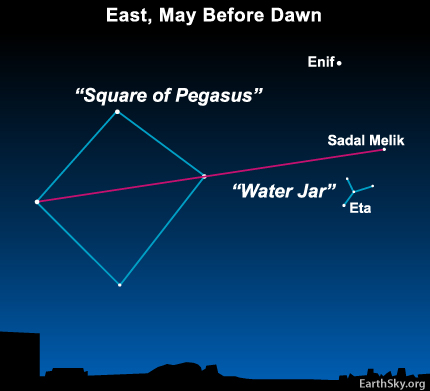
Bottom line: In 2020, the Eta Aquariid meteor shower produces the most meteors before dawn on May 5, though in a moonlit sky.
Read more: Where’s the radiant point for the Eta Aquariid meteor shower?
Read more: Everything you need to know: Eta Aquariid meteor shower
Like what you read?
Subscribe and receive daily news delivered to your inbox.
More from
Bruce McClure


Meet Aquarius the Water Bearer and its stars

Check out the Double Cluster in Perseus on October evenings
Find the Andromeda Galaxy using Cassiopeia
Alpha Cephei, or Alderamin, is a fast-spinning star



