The sky's brightest star, Sirius, before dawn
16 comments Print Me Email to FriendTonight is Monday, Oct 13 2008
Andy wrote, Early this morning, looking southeast, I saw a beautiful star, bright and multicolored. . .Can you identify it for me?
And Paula wrote, This morning two of us got up early. We found a pulsing star straight down the sky below Orion’s belt. It was pulsing the colors of green, yellow, blue and red like a strobe light. I will search for it every morning as it was so enchanting.
It is enchanting indeed, so much so that – every year, beginning in the fall – we get many, many questions about a multicolored star twinkling in the southeastern to southern sky. This star is Sirius in the constellation Canis Major. It’s rising in the southeast in the hours after midnight now and can be found in the south at dawn.
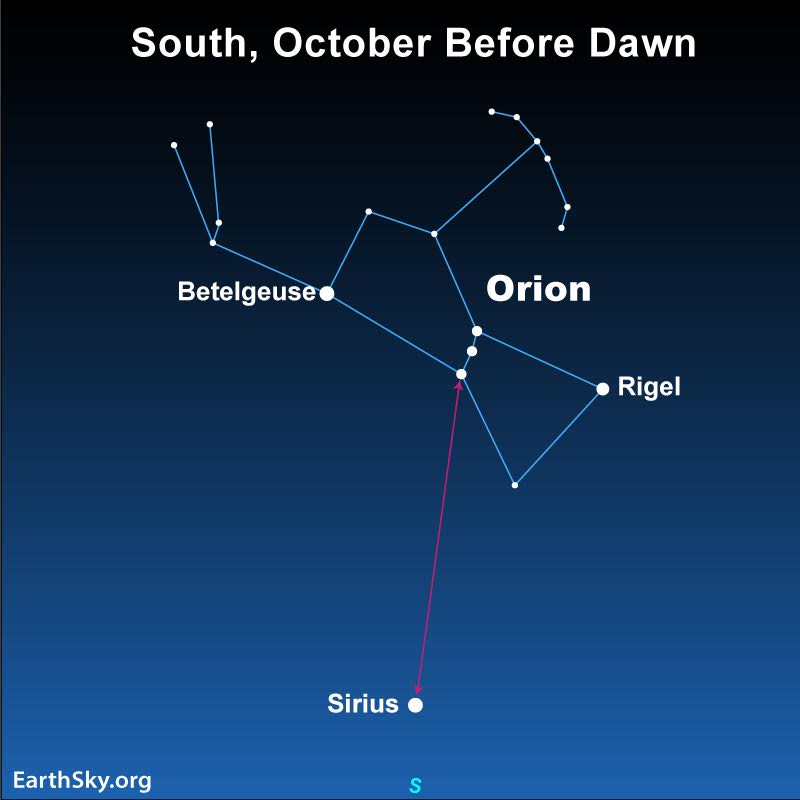
Just don’t mistake Sirius for Venus, which is brighter. Notice that a line from Orion’s Belt to points to Sirius. Venus is now very low in the west after sunset.
Sirius appears to flash different colors when it’s low in the sky . . . really, all the stars are flashing different colors. That’s because light is composed of all the colors of a rainbow, and the journey through our atmosphere breaks starlight into its component colors. But you don’t notice the colors of the other stars as much, because they’re not as bright as Sirius . . . which is the brightest star visible from anywhere on Earth. Since our atmosphere is causing the light to break into its colors, and since Sirius is only visible low in the sky now (where you are peering at it through a thicker layer of atmosphere than when it’s overhead), the flashing colors of Sirius are very obvious when it is low in the sky.
But when Sirius is higher in the sky – which it is before dawn now. . . or in the evening sky this winter . . . you’ll find that Sirius shines with a steadier, whiter light.

Hi,
This is a very informative page.
I have question that may sound a little odd. I would appreciate it if anyone could help me out.
Viewing the sky from the southeast U.S. (NC coast)this time of year 9/02/08 – just before dawn -if I look out toward the location of the sunrise and to the right(south) about 45 degrees and then up also about 45 degrees is a very bright star. Is this Sirius? It is the last star in that direction to fade at sunrise. Just above it aboout 20 degrees higher and 15 degrees further south is another fairly bright star but less than (Sirius -?)
Does any one know if this is Sirius or if not what star it is?
It is important to me – I lost my dog ‘Phoebee’ and put her ashes in the dunes on the beach – after – I looked out and saw this star right before dawn. I closed my eyes for about five minutes while remembering her and saying a prayer for her.
I know this sounds weird but I felt her presence for second then a release that is hard to describe – like she said goodbye. When I opened my eyes the star was gone – it was getting light. I would really love to know the name of that star for ‘Phoebee’.
Thank you for your help,
Henry Rhyne
Henry,
45 degrees sounds too high up to me to be Sirius. However, two bright stars in the constellation Orion – Betelgeuse and Rigel – are roughly that high at and shortly before dawn.
Are you at all familiar with the constellation Orion the Hunter, and especially the three stars that make up “Orion’s Belt”? Before dawn – or at early dawn – see if you can locate Orion in your south to southeast sky, roughly halfway between your horizon and overhead. Draw a line downward through the three stars of Orion’s Belt to star-hop your way to Sirius. I include this sky chart from a recent Tonight’s Sky program to help you out.
Best of luck!
Bruce
Bruce,
Thank you – that helps. I may have had the degree height a little high – maybe a little lower (30-35 degrees).
I did locate the three stars in Orion’s belt and it is below them (almost directly – just slightly east) maybe half way down, toward the horizon. It is the brightest star in the sky at that time and fades last (a little earlier before dawn it almost seems to twinkle different colors).
There is another star close by just slightly above it and just to the south that is fairly bright – (possibly Rigel or the one between Rigel & Sirius) that fades second to last just before the one I think is Sirius.
I’ll do some more research, but I think it is Sirius.
Thank you again for your help.
Henry
Henry,
It sounds to me like you saw Sirius!
Referring to Orion’s Belt, Betelgeuse is to upper left of the Belt while Rigel appears to the lower right. Betelgeuse and Rigel shine on opposite sides of Orion’s Belt, and about the same distance away. If you draw a line from Betelgeuse to Rigel, this line crosses the Belt at almost a right angle. If you look at Betelgeuse and Rigel through binoculars, Betelgeuse exhibits a ruddy color, whereas Rigel looks blue-white.
A bright star at roughly the same altitude (distance from horizon) as Sirius at and before dawn would likely be Procyon, the little dog star. The ancient Egyptians referred to Procyon as “before the dog,” because its rising in the east foretold the rising of Sirius.
I include this chart that depicts more bright stars in that area of the sky for you. Even though this chart shows these stars for early evening in January, this chart works equally well for before dawn in September.
Give my regards to Phoebee!
Bruce
ilove you
What star or planet is there in the evening when the sun goes down? I live in Eatonville and this is the brightest thing in the sky. Is it Jupiter??
I am looking at the Southern sky and this pops out before any other stars at dusk.
I was looking at Venus tonight (yes I’m sure it wasn’t Sirius…it wasn’t twinkling) and for some reason it wasn’t a steady color. It was more rainbow color. I was wondering if it’s just because of the angle I was viewing it from.
Scyren, yes, that’s correct. You would have been looking at Venus at a low angle in the sky. And when Venus is low in the sky, we are seeing it through more of Earth’s atmosphere than when it’s higher up in the sky. The atmosphere splits the light of Venus and causes the rainbow effect.
All best,
Deborah
i’m visiting Buenos Aires, ARG…
Would i be able to see VENUS at sunset as well? …and its rainbow-light effect?
.CLEARSKIES!.
.ernesto.
Ernesto, you can definitely see Venus after sunset! In fact, from Argentina, it will appear higher in the west after sunset than it does from the U.S. But a rainbow-like effect would depend on exactly when you saw Venus – how close to the horizon – and also the exact conditions of your sky.
Clear skies to you!
Deborah
Why does the moon appear to be shining so much brighter tonight? It appears to glow around the outside areaof the moon. It looks like a ring aound the moon.
RE: “…Sirius . . . which is the brightest star visible from anywhere on Earth.”
Hate to nitpick, but isn’t our Sun, Sol, actually the brightest star visible anywhere on Earth?
Hi Marie, halos around the sun or moon are caused by high cirrus clouds … light is refracted or “split” to form the halo.
Hi Mark. You are correct. Thanks!
Deborah
All of you that have questions about the stars really need to download this amazing freeware program about the Stars and Sky, it is nothing short of amazing! here is the link to the program called Microsoft Telescope, enjoy! http://dailyfreeware.net/2008/10/30/microsoft-worldwide-telescope/
Its Nov. 15,2008. I I counld not sleep—So around 2 am I went out side—looking at the Stars. I thinking I seen the star you are talking about. Sirius: I never seen this star before. Is look like almost 2 star very closed & flashing with beautiful color light, like a dimond does. It was not close to Moon. It was South in shy where I live. It is one of the most beautiful Stars I ever seen. I could see it very clear. I live in Northern Calif-right outside Sacremento. Is this the same star or another star—In my back yard I face South-West. Just wondering if a nother star—or maybe something elsa going on in shy. Awesome Pages Thank You so much for sharing this. Lacey
Many people mistake planets for stars. During the 30 minutes prior to and after dusk and dawn, you are probably seeing planets, especially if they appear very bright. There is too much light in the sky, to veiw stars at these times of day.
The following is directly from a Houston Observatory, and depending on where you are, it changes.
“The ‘main event’ of November evenings occurs in the southwest at dusk, where you can watch Venus close in on Jupiter. Look southwest right as night falls for the two brightest things there except for the Moon, which is nearby at the beginning of the month. The brighter one low in the southwest is Venus, which outshines everything in the sky except the Sun and the Moon. Jupiter is closer to due south at dusk and is the dimmer of the two, although it still outshines all stars we ever see at night. Venus and Jupiter begin the month just under 30 degrees apart (your fist at arms length blocks about 10 degrees). However, Venus will close that gap quite noticeably each night, until it appears directly under Jupiter on November 30. The two planets will then be about 2 degrees apart. When two or more planets are roughly in the same line of sight, astronomers say they are in conjunction. Saturn is now higher in the east at dawn. Mars is lost in the Sun’s glare this month, and will remain out of sight into 2009.”
AND THIS IS MOSTLY FOLKLORE………….. Original Source of the Term “Dog Days”
Sirius, the brightest star in the sky, is the original source of the term “dog days of summer.” Although there appears to be a wee bit of disagreement and/or confusion on the matter… the “Dog Star” Sirius apparently originated from the ancient Egyptians that named the bright star Sihor after their powerful dog-headed divinity Anubis. Later traditions, it would seem, associated the Dog Star with the Egyptian god, Osiris.
In ancient Egypt, the dog star Sihor rose along side the Sun when summer was at its very hottest. Oddly enough, the ancient Egyptians celebrated the return of the “dog days,” because the rising of the Sun – combined with the Dog Star – announced a very good and significant thing.