
Dry Tortugas

download Help
8723.jpg

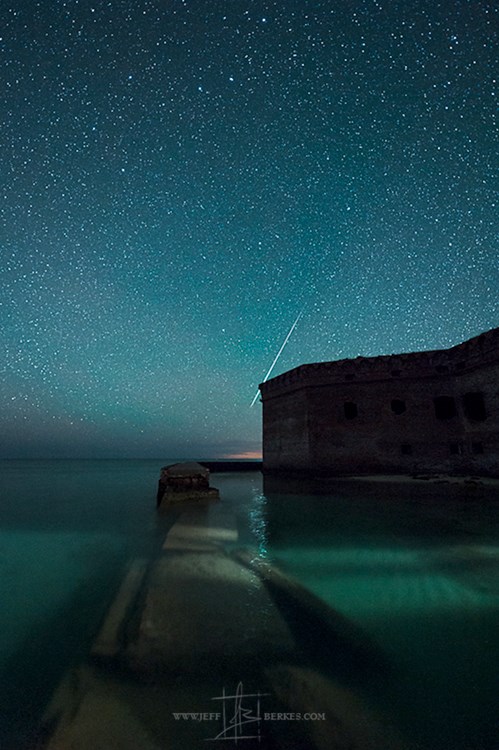
Fort Jefferson on the Dry Tortugas. Image courtesy NPS.

JB: This is Earth and Sky. The Dry Tortugas are a cluster of 10 sand and coral reef keys over 100 kilometers – or about 70 miles – out in the Gulf of Mexico – off Florida’s Key West.

DB: At some point, oceans currents from the entire Caribbean Sea and Gulf of Mexico pass by the Tortugas. That’s why spiny lobsters, crab and conch reproduce there . . .

JB: . . . as well as yellowtail snapper, hogfish, tilefish and snowy grouper. Ocean currents sweep some of the larvae and offspring north, helping sustain fisheries and ecosystems throughout the Keys and along the southeast coast of the U.S. Unlike the coral reefs in the Florida Keys, the Tortugas coral reef ecosystems are still healthy. They haven’t changed significantly in the past 40 years.

DB: There’s been a bird sanctuary on the Tortugas since 1903 – North America’s only breeding ground for sooty terns, brown noodies, and masked boobies – all of which depend on fish for prey. Parts of the Tortugas have long been a national park. But now the Dry Tortuga’s entire area has been designated as a National Marine Sanctuary.

JB: Special thanks today to the U.S. Forest Service and the National Fish and Wildlife Foundation – supporting the conservation of native fish, wildlife, plants and their habitats. We’re Block and Byrd for Earth and Sky.

The following individuals were interviewed for today’s show. Our thanks to:

Joe Di Novo
Big Pine Key, FL

Richard A. Snyder, Ph.D.
Center for Environmental Diagnostics and Bioremediation (CEDB) Biology Department
University of West Florida
Pensacola, FL

Brian D. Keller
Science Coordinator
Florida Keys National Marine Sanctuary
Marathon, FL

The following books, articles and web sites were used in preparing this script:

Florida Keys National Marine Sanctuary – Tortugas 2000 (National Oceanic and Atmospheric Administration)

Dry Tortugas National Park (National Park Service)

Florida Fish and Wildlife Conservation Commission

Author’s Notes:

The Tortugas boasts a number of “firsts” including the location of the world’s first underwater photograph, the world’s first marine protected area (Fort Jefferson National Monument, est. 1935), and the first tropical marine laboratory in the Western Hemisphere (Carnegie Institute of Washington’s Tortugas Marine Laboratory, est. 1904.)

Since the days of Spanish exploration, the reefs and shoals of the Dry Tortugas have been the site of hundreds of shipwrecks – legends of pirates and sunken gold.

In the area dubbed “Sherwood Forest,” coral cover often exceeds 30%, compared to an average of 10% elsewhere in the Florida Keys.

All the Tortugas are low and partially covered with mangrove ushes.

Additional Teacher Resources

U.S. National Oceanic and Atmospheric Administration, Public Affairs: Tortugas 2000: Protecting Florida’s Coral Reefs

The National Oceanic and Atmospheric Administration, working in collaboration with other federal, state, and territory stakeholders, proposed to establish an ecological reserve to protect the best remaining coral reef habitat in the Florida Keys?the Dry Tortugas. This report discusses the events leading up to the implementation of the ecological reserve and its progress as of 2000. The site also contains links to more information.

U.S. National Park Service: Dry Tortugas

This is the official Dry Tortugas site of the National Park Service. It provides a history of the park, news releases, a description of ecosystem and, a section for kids.

U.S. National Oceanic and Atmospheric Administration, National Center for Coastal Ocean Science: The Tortugas Ecological Reserve? How is this Seascape of Promise Working?

This article explores the successes and failures of the Dry Tortugas Ecological Reserve since its inception. The goal of the inquiry is to better understand the real world impacts of the designation of ecological reserve.

© 1996-2007 EarthSky Communications Inc. All Rights Reserved.

Design © 2006-2007 lucid crew | austin web design
