
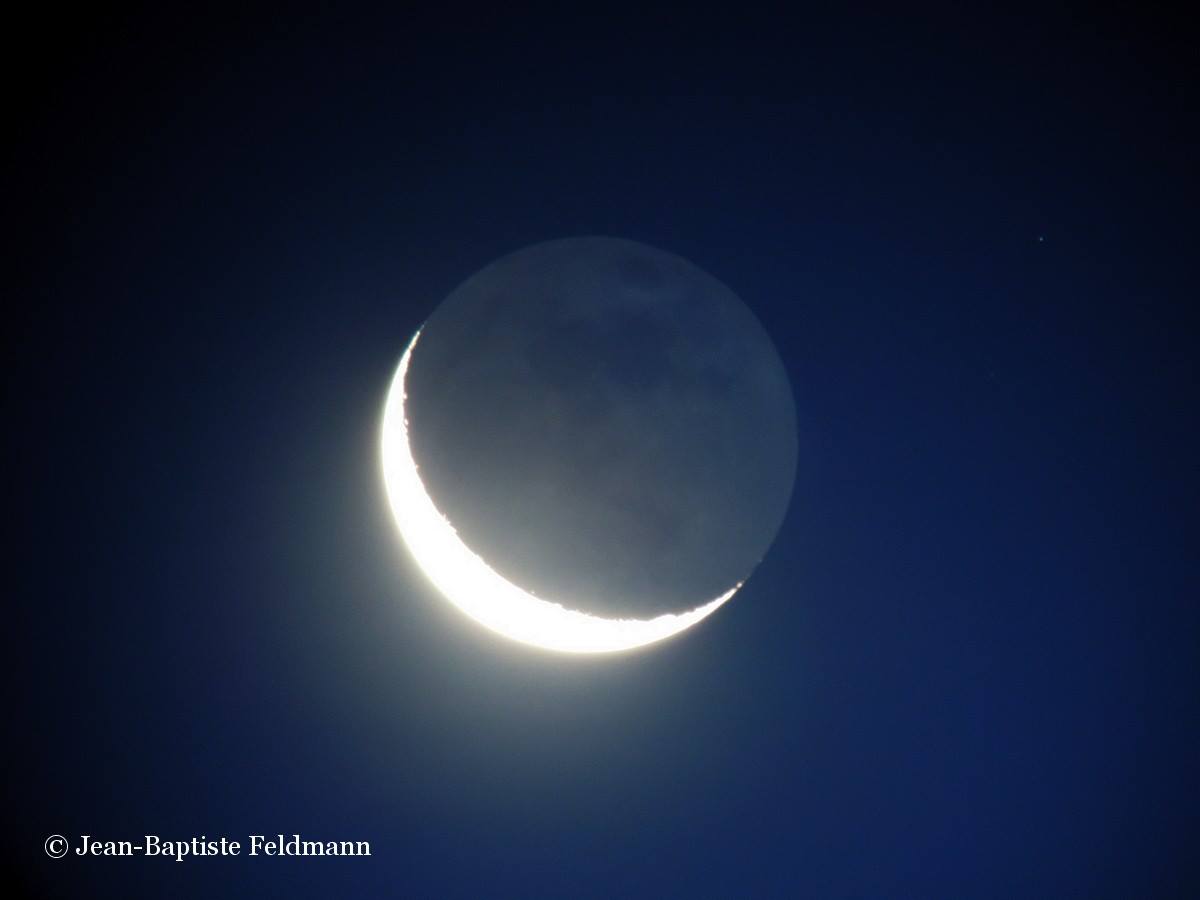
Earthshine
Earthshine in the Texan hillside. Credit & Copyright: Russell Croman.
DB: This is Earth and Sky. When you see a crescent moon, you can often see a glow on the darkened part of the moon.
JB: Leonardo Da Vinci correctly explained this glow in the 1500s – it’s sunlight bouncing from Earth to the moon. This glow is called “earthshine.” And scientists have been using this ghostly glimmer to measure the total amount of light reflected by our planet. Earth’s reflectivity is called its “albedo.”
Enric Palle: When we measure the earthshine, what we we’re measuring, in a way, is clouds – clouds on a global scale. And what we find is that, from season to season, we see a great deal of change in the albedo measurements, which was sort of unexpected.
DB: That’s Enric Palle, a scientist at Big Bear Solar Observatory high in California. He says that any sunlight striking Earth that isn’t reflected drives our weather and climate. Thicker clouds act like a mirror – they reflect more sunlight and make Earth cooler.
JB: Thinner clouds let more sunlight though – so Earth is warmer. Current climate models treat Earth’s albedo as constant. But Palle’s team has been looking at earthshine since the 1980s – and he says it’s not constant after all. He says Earth’s changing reflectivity is one more piece of the climate puzzle.
DB: Thanks today to the National Oceanic and Atmospheric Administration, and to the National Fish and Wildlife Foundation. We’re Block and Byrd for Earth and Sky.
Links:
A great place to start for further information about the Earthshine project is the Big Bear Solar Observatory website.
Great description of Leonardo Da Vinci’s original codex on display at the American Museum of Natural History
Earthshine Measurements of Global Atmospheric Properties (PI: Philip Goode)
Interview with Enric Palle:
ES: Thanks for talking with Earth and Sky today. Can we start with some background of the work you’re doing out at Big Bear on the Earthshine project?
EP: What we do is, every night we take measurements, and we take pictures of the moon. And we take pictures of the bright side of the moon, which is sunlight, reflected by the moon towards the earth, towards the night side of the Earth. We also use a blocking filter which coats the bright side and lets us take pictures from the dark side of the moon, which is called the earthshine. And the brightness of this part comes from light, which is reflected on the dayside of the earth and is bounced toward the moon, and bounces back toward the night side of the earth. And when we do the ratio between the two, from the bright side we know how much energy, or how much light the sun is putting out. And from the earthshine, we know how much of this energy the earth is actually not using at all – it is reflecting back into space. And that is what we do, we keep measuring this, and we measure it daily, and we hope to understand how the albedo, which is the fraction of the energy which is not used by the earth, is reflected to space, how much the albedo changes every day, in a matter of hours, days, months, and years. And that is what we do.
ES: How long has your lab been measuring this?
EP: We have continuous measurements, nonstop, since December 1998. But the project started earlier. There were some measurements during 1994 and 1995, and then, because of funding, they were stopped for a while. And they started again in 1998. We have funding for the next three years.
This is a really long-term project. Actually, what we are doing is that we are expanding. Since 1998, we have measurements from Big Bear. But last year, we set up another station in Columbia, in Russia, and right now we have another telescope built, that is being calibrated, and we’re going to ship it at the end of summer to China. So by the end of the year, we’ll have three telescopes looking at the earthshine. And if we are able to get funding, what we are going to do, next year we are going to build a network of eight telescope, and they will be robotic so that it won’t be necessary for a person to stay there all the time. And we’re going to deploy these telescopes all around the world, so that we have a continuous measurements of the earthshine, 24 hours.”
ES: Dumb question, but why have eight telescopes? What advantage is that to just one?
EP: Because the times that we can observe that the earthshine has a twenty four hour rotation, and the albedo is a quantity that exists over the whole dayside of the earth. When we have a telescope at Big Bear, it’s only night time half of the day, 12 hours, and we can only observe for three or four hours. So our coverage is only three or four hours out of the 24. If we have eight telescopes all around the world, we can measure the earthshine, and the albedo, continuously. So our temporal coverage is increased.”
ES: Can you describe a little bit about what the instrument is that you’re using, and what is it that you’re measuring?
EP: The instrument is a very simple reflecting telescope. It could have been built a hundred years ago. It’s very simple – it has an aperture of 10 centimeters or 15 centimeters. And what’s important is the camera at the end. It’s a CCD camera, a good camera, and a filter wheel, which, what it does, is that when we want to observe the dark side of the moon, we just put this filter in a position which changes every night, which blocks the bright side. Because what we are doing is that we’re looking at the faint objects, which is the dark side, very, very close to a very, very bright object, the bright side [of the moon]. And we have problem with scattered light. So in order to see the signal, you have to block the bright side. But the optics are really, really simple. Any amateur could build one in his backyard.”
ES: So what does earthshine have to do with Earth’s climate?
EP: Let me put that in context. You have the Earth, and the Earth has some climate. All the climate systems, all the weather that happens on the Earth, is driven by one source of energy, which is the sun. The sunlight reaches the Earth and is absorbed by the atmosphere and the ground, and the Earth’s surface, and the oceans. And then, the redistribution of this energy toward the poles is what triggers the whole climate systems. So, if you want to produce climate change, if you want to warm the Earth, then you have two ways to do it. One of them is to change the amount of energy that is reaching the Earth. And after this energy is absorbed, it is re-emitted toward space in the infrared range. So, one thing you can do is to change the amount of greenhouse gasses that you have in your atmosphere. And one thing that will do is trap the infrared energy, warming the planet. But another way you have to change the temperature of the Earth is by changing the amount of energy that it gets from the sun. And to change that, you have two ways, which is changing how much the sun is outputting. So we have satellites in the last 20 or 30 years that do tell us that there is a change with the cycles that happen in the sun. As the sun gets more active, it radiates more energy. But those changes in the sun are really small. So in order to have an effect on the Earth, what you can also do is change how much of the energy the Earth is actually using, or how much of the energy is actually reflected back into space and is never used. And this is the matter of clouds. Clouds are the ones who mostly determine the albedo and the changes in albedo from year to year. So if you are to change clouds, if you put more clouds on Earth, and you put more clouds on Earth, more sunlight would be reflected back, and you would cool the Earth. So that’s what we’re trying to measure.
When we measure the Earthshine, what we we’re measuring, in a way, are clouds – clouds on a global scale. And what we find is that, from season to season, a great deal of change in the albedo measurements, which was sort of unexpected. Because the models that we had did not predict these large changes in albedo. And, more importantly, on long time scales, we were able to reconstruct albedo measurements for the past two decades. So what we see is the albedo, which is normally considered a constant, in carbon sequestration models, it actually changes a lot from year to year. And it is able to produce climate changes that are large – very large, larger than what CO2 can do in a hundred years. But we still don’t know what produces these changes. We know they are produced by changes in cloud cover, but we don’t know what changes the clouds. And we don’t know whether this is a short time thing or if it’s an ongoing process. So we really need to know that to determine climate change. So that’s what we do.
Well, what we do first is radiative photometry, which is – we don’t do absolute, but we do have an absolute number of the counts on the bright side of the earthshine. But what we do is radiative photometry, which is much more precise than absolute photometry, which would be to take an image on the bright side and count, and get the number of photons. What we do is we get the relative measurement of the bright side to earthshine. It’s not so much how bright is the dark side, but how much is the bright side as compared to the dark side. Now, this takes away lots of calibration problems with our data. So we are fairly certain that our data is okay. And, when we reconstruct our data, our data agrees with the satellite observations of cloud cover, and there are also other sets of satellite data from different satellites which actually look at the Earth’s radiation budget, which is they just measure how much energy is on the short wave is coming into the system and reflected outwards, and how much infrared energy is emitted by the Earth towards space. And those sets of measurements do agree. Those satellites are restricted over the tropical areas, whereas we are global. These data do agree with what we are saying and what we are claiming. So we are fairly certain that our results are okay, that they are fairly robust.
Why then don’t the models explain it? I think that the problem is in the model’s side, and not in our measurements. Because, what the models cannot predict, over the last few years we’ve been seeing that the Earth’s radiation budget, which is the equilibrium of forces between incoming and outgoing radiation on the Earth is actually much more variable on both ends – on the short wave, and on the long wave – than what the models predict. And the observations are overwhelming that the models are missing some parts which reflect in a star’s variability on a decadal time scale.”
ES: It’s pretty incredible that the change in albedo from the 1980s to the 1990s is comparable to taking the effects of greenhouse gas warming since 1850 and doubling them.
EP: The amount of greenhouse gasses in the atmosphere is increasing exponentially, continuously, since 1850 to the present time. What we should take into account is this. All of the CO2 that we’ve put into the atmosphere, for the last 150 years, has produced an effect that is estimated to produce an effect of 2.5 watts per meter squared. That’s a measure of energy, of how much extra energy is being trapped on the Earth, and that extra energy is going to be used to warm up the planet. Now, what we see on the earthshine, over 50 years, the change is about 5.8-6 watts per meter squared, which is more than two times that, of energy that has been allowed to reach the atmosphere, and the ground, which before, at the beginning of the eighties, was actually reflected outside. That’s twice that amount. But, before comparing those things, one has to have one thing in mind, and that is that the climate system has some memory. And if you clear some clouds and actually open the Earth to more incoming energy, the Earth will take its time to actually warm up. So the greenhouse gasses have been sort of heating the planet constantly, by a small amount, but constantly, over the last 150 years. Now, the albedo may have dropped by a huge amount in ten years. But if it’s going upwards again, and then down again, and then up again, and then down again, in a sort of ten year time scale, well you will see the effect on the Earth’s temperature will be much smoother – because the changes will smoothed out by the ocean’s thermal inertia. So what you will see is a smaller effect than the measurements are showing. It’s a matter of time scales. If the result that we had shown had been a step change, it would produce a measure of climate change. But if it’s a sort of sinusoid, up and down, then the effect will be much smoother.
The key sentence here is, if everything else was constant, the only thing that we would see is that the albedo would be decreasing from the 1980s to the year 2000. That would mean that there’s less energy reflected towards space, so there’s more energy entering the Earth, and this extra energy would warm the planet. So what you would see, with some delay, the temperature is going up from the 1980s to the year 2000. And that’s exactly what we see on the Earth. And then, if the albedo turns around, and it starts to turn around in 2001, it means that the Earth would actually be reflecting more energy out to space, so there will be a cooling, which will be delayed. It could start this year, last year, next year. So the Earth would cool back to the temperature that it had in the 1980s. But the key question here is – with everything else constant. Because if at the same time, CO2 is increasing, or any other changes that we are producing, we are putting more aerosols into the atmosphere, there is some special El Nino event this year – all of these things will contribute to climate. So it is very difficult to isolate the signal from the albedo. The albedo is one player on the climate system. If all of the other players are constant, what this variation is telling us is that the climate should have warmed a lot over the last decade, and that it would cool off over the next 10 years. But, we need to know all the players, what they are doing.”
ES: For the benefit of our listeners, would you explain a little more about what albedo is?
EP: The albedo is a number between zero and one, with no units. It simply states how much of the energy from the sun is reflected back into space. So, if the albedo of a planet would be zero, it means that all of the energy that would be incoming from the sun would be absorbed by the Earth, which is to trap everything. If the albedo would be one, it means that the Earth would be a perfect mirror, that all the energy coming from the sun would be reflected to space and never used. So the albedo of the Earth is around .3 – about 70% of the energy that the sun throws at us, we absorb, and 30% we throw back into space.
And, what causes the albedo is almost everything. The land reflects some light towards space, snow would be a very large reflectance, a desert would reflect a lot of light. When you are skiing, you get a bronze tan, because the ground around you reflects all the sunlight, so you get the sunlight coming from the sun plus the one that is reflected from the ground, so you get twice the amount of sunlight.
At global scales, when you see the Earth as you would see it from the moon, what actually reflects a lot of energy, a lot of sunlight, are the clouds, mainly the clouds. The desert, the snow, and the ice all over the Earth – it’s more or less a constant parameter. What really changes a lot from year to year is the cloud cover, and with the seasons – the large scale cloud cover of the Earth. That’s what reflects most of the sunlight out towards space.
In a given day, if it’s cloudy or sunny on a certain place of the Earth, it depends on the weather for that day or that region. If you look at the Earth as a whole, the weather part is sort of fixed. You have very low clouds in the sub-tropics, for example, and you have lots of clouds at mid latitudes, low clouds. But the weather patterns do also move around. But when you look at it over a month, or a year time scale, the cloud patterns over the Earth are more or less fixed. They change in intensity put they are more or less fixed.
ES: So our current knowledge about albedo has been pretty limited?
EP: To study the albedo, there hasn’t really been any study at all which, as we have long-term measurements of the solar radiance or the amount of greenhouse gasses in the atmosphere. We don’t have a long-term trend of measurements of the albedo. There’s been a few satellites up there since the beginning of the eighties, which have been able to measure the albedo from space. But what happens is that there are different satellites with different instrumentation. They went up, they measured for a few months, for one year, but there is no continuous calibration from one to the other. There were some instruments, which were called the Earth’s Radiation Budget Experiment, they were able to, by extensive calibration of different satellites, reconstruct the time series of the albedo – but only over the tropical regions, +- 20 degrees in latitude. So a global albedo data set simply does not exist. So, the only other way to measure it, apart from satellites, is from the ground using the earthshine. And that has been going on since 1994. That’s why we’re hoping to continue these and to provide a long-term series of albedo measurements which will probably shed some light on a key parameter of climate change.
ES: What are some of the things you expect to see happening in the Earthshine project over the long-term?
EP: Well, the long term will come in a long term, right? But one of the things that we want to immediately measure over the next five years is whether there is a solar cycle probability in the Earth’s albedo. Some authors have proposed that there is a link between solar activity and cloud cover on Earth. And if there is, then you should see – you know that the sun varies in eleven year time scales, there’s what’s called the solar activity cycle. And if this happen, then you would see a mimic pattern on the Earth’s albedo of about eleven year variability. We also want to see, as climate changes, what happens to clouds. And one way to answer that is to see what happens to the albedo. Because if the albedo is going upwards, then we know that there are more clouds, generally. And if it’s going downwards, then we know that there are less clouds. And the clouds are really, really important parameters to predict climate change and to understand climate change – because they have a huge impact on the energy balance of the Earth. In fact, I think that cloud parameters are acknowledged by all climate scientists as the major unknown parameter in their climate models. So if we are able to know how the clouds respond to climate change and to solar activity, than we may be able to predict better what will happen in the future, what the Earth’s climate will be like in 50 years or a hundred years.
You see, climate change is a very complex thing. You cannot simply measure temperature, or pressure, or albedo and deduce what is producing climate change and what will happen. What you have to do is really put together lots of studies, with lots of different aspects on climate, and see how well they are consistent with each other, how well they agree with each other, and the quantities and the absolute numbers, and build a whole climate theory based on that. What we’re doing is – up to now there was a parameter called albedo, which nobody knew the exact value or how it behaved with time. Now we know that. And we can incorporate that with greenhouse gas measurements, measurements of solar irradiance models, and slowly know more about the climate system.
The earthshine is something that is not very straightforward to understand. I think one of the beautiful things about the Earthshine Project is that is mixes astronomy with climate change, which is something that is not very often seen. That’s the beauty of the project and that’s why it attracts the attention of a lot of people.
ES: What was something that surprised you over the years of studying earthshine?
EB: The first thing that surprised us, a couple of years ago when we had enough data, was the large seasonal variability of the Earth’s albedo – how it changes from May to July. It was a huge change – of like 20% in the albedo value. That was large, and nobody expected that.
On the long-term trend, how it has changes from year to year, from decade to decade, no one knew what to expect. So yeah, it did surprise us, but it didn’t not meet our expectations, because we didn’t have expectations. It was an unknown, so that’s what we got.
The following person was interviewed for today’s program. Our thanks to:
Enric Palle
Post-doctorate Research Associate
Big Bear Solar Observatory
New Jersey Institute of Technology
Big Bear City, CA
