Phytoplankton
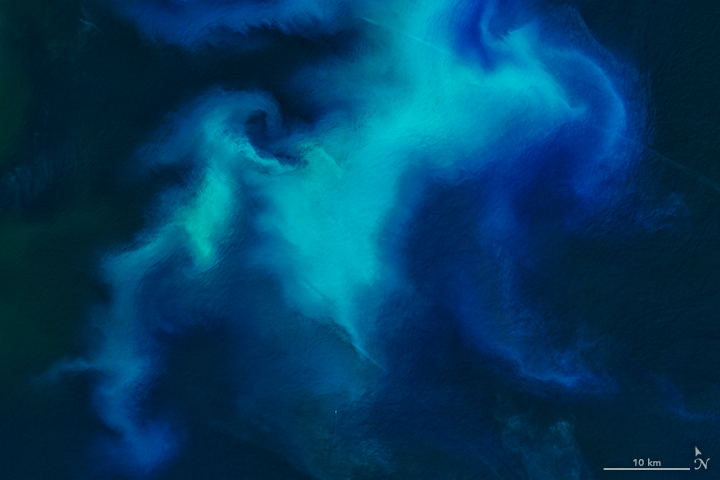
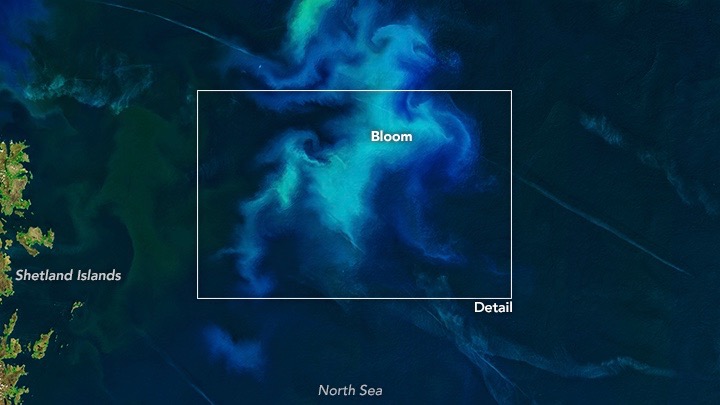
Phytoplankton form the base of the ocean food web, and they are crucial to the interrelationship between Earth?s oceans and climate. The type of phytoplankton shown here is a diatom, meaning it has an outer skeleton made of silica.
JB: This is Earth and Sky – on phytoplankton – tiny plants floating in oceans throughout the world.
DB: In some places, a jar of ocean water would contain millions of tiny plankton. They form the base of the ocean food web and produce about as much oxygen as plants on land. As Earth’s climate warms, ocean circulation patterns and nutrient levels might shift, changing how quickly plankton grow.
JB: Phytoplankton, in turn, can influence climate. They absorb the greenhouse gas carbon dioxide, so if they grow faster, they might help slow greenhouse warming. Mike Behrenfeld of Oregon State University says scientists can measure the amount of phytoplankton in the ocean, using satellite images. But it’s been harder to measure how fast they’re growing.
Mike Behrenfeld: . . . the phytoplankton are being eaten by ocean animals about as quickly as they are growing. And so you can have this population that’s growing really slowly or a population that’s growing fast and you don’t see a change in biomass. . . .
DB: Behrenfeld has developed a mathematical technique that uses the different colors of light recorded in satellite images to determine the “greenness” of phytoplankton. This reveals the phytoplankton growth rate. He’s now helping design a satellite to take full advantage of this technique – hoping to help scientists who study the links between the ocean food web, ocean circulation patterns and climate change.
_DB: Our thanks today to NASA explore, discover, understand. We’re Block and Byrd for Earth and Sky.
For decades, ocean scientists struggled to find a way to measure how fast phytoplankton were growing across large areas of the ocean. As an approximation, scientists took snapshots of the ocean from space. Depending on how green the water was, they estimated the biomass – or shear mass of phytoplankton – in an area of ocean. But scientists couldn’t easily measure how active the phytoplankton were – how quickly they were growing, reproducing and absorbing carbon.
The new technique for measuring the growth rate of phytoplankton that was developed by Behrenfeld is based on the idea that the “greener” each individual phytoplankton cell is, the faster it’s growing. So, the overall “greenness” of a patch of ocean divided by the number of phytoplankton cells in that patch indicates how quickly the phytoplankton are growing. By carefully comparing the amounts of different colors of light in satellite images, Behrenfeld’s team have figured out how to count how many phytoplankton cells there are – and hence how fast they’re growing.
Scientists believe that phytoplankton contribute between 50 to 85 percent of the oxygen in Earth’s atmosphere. For more on that subject, read Earth & Sky’s How much do oceans add to worlds oxygen?.
Our thanks to:
Michael Behrenfeld
Professor
Department of Botany and Plant Pathology
Oregon State University
Corvallis, OR
Additional Teacher Resources
NASA: What Are Phytoplankton?
Phytoplankton are microscopic plants that live in the ocean. There are many species of phytoplankton, each of which has a characteristicshape. Collectively, phytoplankton grow abundantly in oceans around the world and are the foundation of the marine food chain. Small fish, and some species of whales, eat them as food. Larger fish then eat the smaller fish. Humans catch and eat many of these larger fish. Since phytoplankton depend upon certain conditions for growth, they are a good indicator of change in their environment.