



Watch this video to learn about the amazing platypus. Image via Charles J. Sharp/ Wikipedia (CC BY-SA 4.0).
Of all the curious animals in the world, the platypus is undoubtedly one of the most peculiar. It lays eggs like a reptile, produces milk like a mammal and swims like a fish. So what kind of animal is it? Well, it’s a toothless mammal with a duck’s beak, a beaver’s tail and the fur of an otter. And if that weren’t enough, it glows under ultraviolet light and is venomous.
Science matters. Wonder matters. You matter. Join our 2025 Donation Campaign today.
What does a platypus look like?
Known by the scientific name Ornithorhynchus anatinus, the platypus is a mammal that measures 12 to 25 inches (30 to 64 cm) in length from the tip of its beak to the end of its tail. Females are slightly smaller than males. A platypus weighs 3.3 to 5.5 pounds (1.5 to 2.5 kg) and has a life expectancy of up to 17 years in captivity and 12 years in the wild.
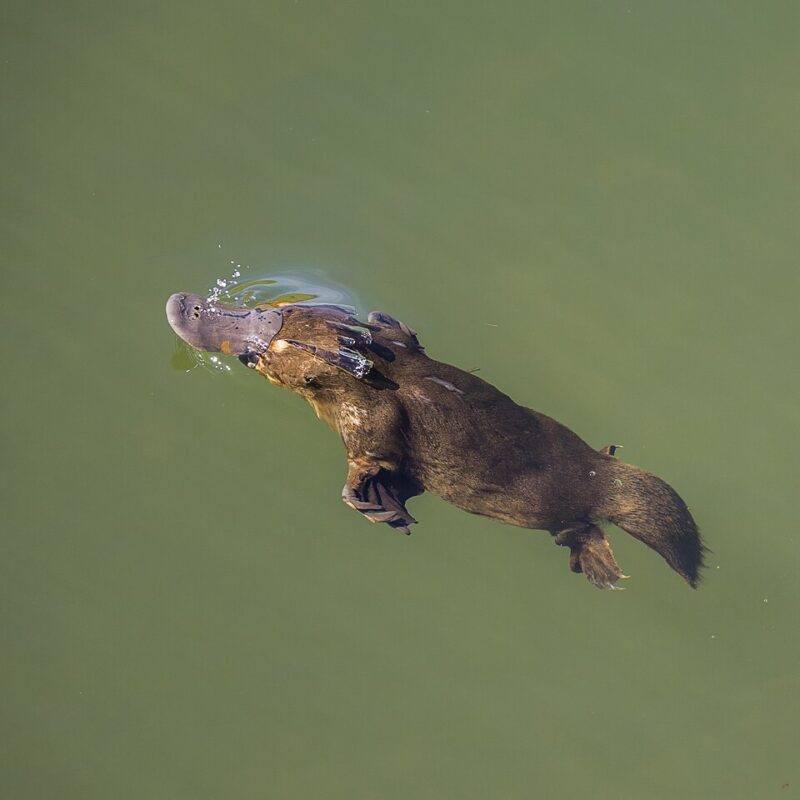
These mammals are elongated and hydrodynamic. This means they’re adapted for life in the water, just like otters. Platypuses are excellent swimmers who hunt underwater. They also have dark brown fur on their backs and light brown or grayish fur on their bellies.
Their fur is dense, waterproof and acts as thermal insulation. It also allows them to float in the water. It is made up of two layers: a longer outer layer and a softer, denser inner layer, which helps keep them dry and warm.

A platypus has an excellent locomotion and sense of smell
Just as fish use their fins to move, balance and maneuver in the water, platypuses rely on their four webbed feet and beaver-like tail. These agile mammals typically use their front feet for propelling themselves. And they use their hind feet, along with their tail, to steer like a ship’s rudder. They also use their tail to store fat reserves.
Each foot has five toes with sharp claws. When on land, the webbing retracts and the claws become more prominent, allowing them to walk and dig. But platypuses prefer to walk on their knuckles to protect the webbing.
They also have a beak that acts as a sensory organ. The beak is highly sensitive to chemical changes in the water and electrical currents, allowing it to locate prey underwater and detect the presence of predators or even a mate.
Platypuses also have an ocular membrane that helps protect their eyes when they are submerged in water. This transparent membrane allows them clear vision even underwater without the need to completely close their eyes.
In any case, it is common to see these animals moving and hunting with their eyes completely closed, as their extremely sensitive beaks are more than enough for navigation. A membrane also covers their ears to prevent water from entering their bodies.
Their nostrils, located on the top of their beaks, are also hermetically sealed. A platypus can remain submerged for one or two minutes. However, they can also move around out of water. In fact, on land, they move similarly to a reptile. Their legs are located on the sides, not on the bottom, as is the case with other mammals, so they practically crawl on the ground.
A beak armed with a powerful tool: electrolocation
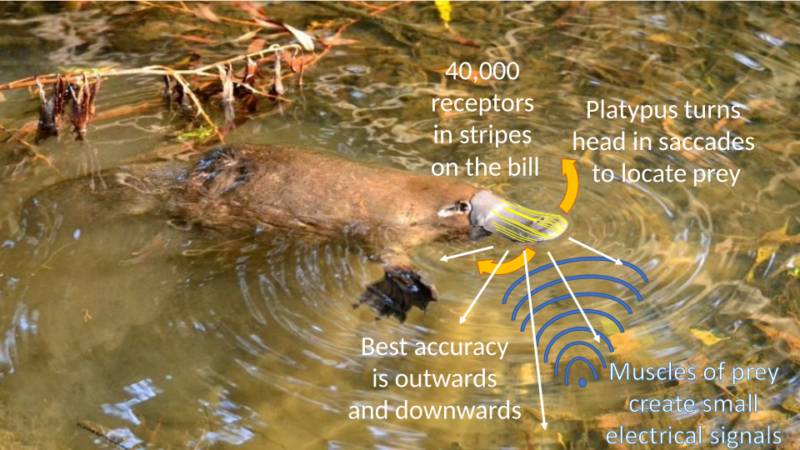
Do you know how our muscles work? The brain sends electrical signals that travel through the nerves to the muscles, causing them to contract and move. Well, platypuses are capable of detecting this subtle activity.
Platypuses use something called electrolocation. This is a way of perceiving the environment through electrical fields. And this ability allows it to detect the muscular activity of its aquatic prey or predators, even in murky waters, thanks to special receptors in its beak.
Thus, the platypus’ beak is a specialized sensory tool, with thousands of mechanoreceptors and electroreceptors that sense pressure, movement and subtle electrical fields.
Mechanoreceptors are cells that detect the subtle movements of water that other animals produce. Meanwhile, electroreceptors detect the weak electrical fields the living beings emit, which helps the platypus differentiate them from inanimate objects.
On the other hand, receptors in the beak can also detect water pressure, allowing the platypus to identify the type of prey nearby. Furthermore, although the beak physically resembles that of a duck, it is not hard. Rather, it is soft and rubbery, which makes it easier to detect movements and feel everything around.
These receptors work together to send the brain the information needed to navigate without having to use smell or sight. This is a useful system, as the platypus usually closes its eyes and can barely hear underwater.
Male platypuses are venomous
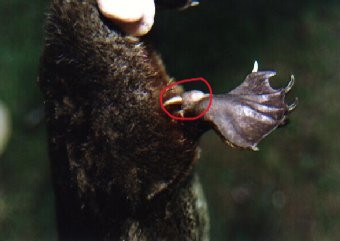
Males have spurs on the back of their ankles connected to a venom gland located on their thighs. The venom released is enough to kill a medium-sized dog. It is not fatal to humans, but it is very painful and causes swelling.
Furthermore, the venom is most abundant during the breeding season. This leads scientists to believe that it is used to defend mates and resources from rival males.
Females are also born with spurs on their ankles, but they are not connected to the venom gland. In addition, the spurs disappear in females when they reach adulthood at about a year old.
The platypus is a biofluorescent animal
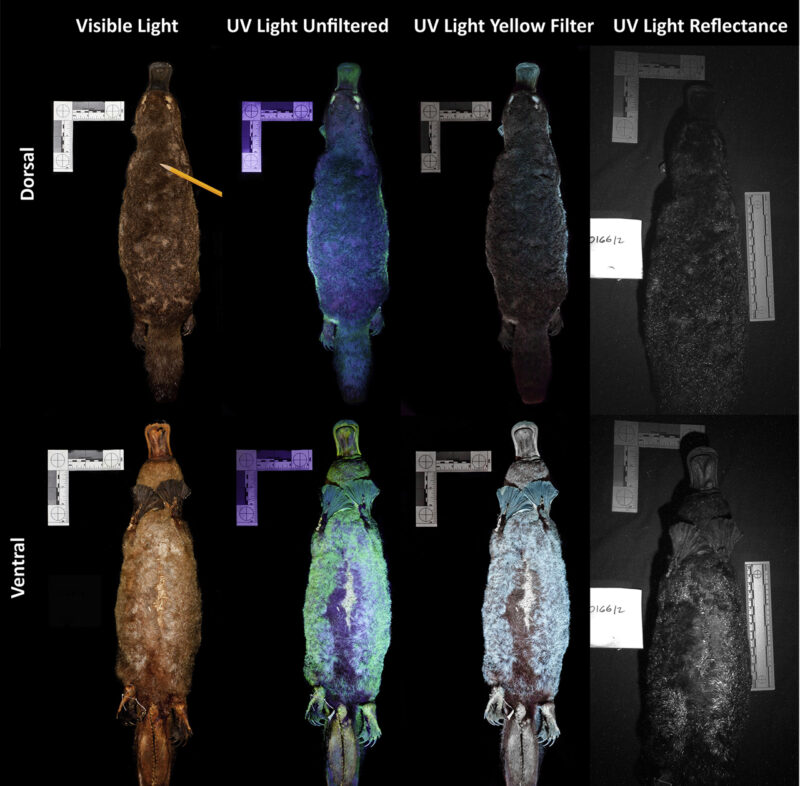
Platypuses also glow blue-green when illuminated with ultraviolet light. This is a spectrum of light not visible to the human eye. Biofluorescence, in the case of the platypus, is a process in which its fur absorbs ultraviolet light (200 to 400 nanometers) and re-emits it as visible light, with a blue-green color (around 500 nanometers).
Scientists still don’t know the cause of biofluorescence in platypuses, but they think it has several functions. It could be a way for them to communicate with each other in low-light conditions or to attract mates during mating season.
Some researchers suggest biofluorescence could help platypuses camouflage themselves with their surroundings, especially in murky or heavily vegetated waters. It is also possible that some predators cannot detect fluorescence, or that it deters predators by making them appear less attractive.
Platypuses don’t have a stomach
Platypuses are carnivorous animals that feed primarily on aquatic invertebrates in streams, lakes and freshwater bodies between 3 and 16 feet (about 1 to 5 meters) deep. They eat larvae, insects, small crustaceans, worms, fish eggs and small fish. They also store their prey in cheek pouches and swim to the surface to eat.
Interestingly, these creatures don’t have a stomach. They have lost the genes responsible for producing acid and digestive enzymes in the stomach. So their digestive system has adapted to intestinal digestion. That is, ingested food passes from the esophagus directly to the small intestine.
Platypuses don’t have teeth like most mammals; instead, they have hard, keratin-covered plates in their bill that they use to grind food. They also pick up gravel or pebbles with their beaks to help them chew their food. So, they swallow the soft parts and spit out the exoskeletons and gravel.
Each day, a platypus needs to eat approximately 20% of its body weight, so they usually spend their time foraging for food. They’re also most active at night. When they’re not hunting, they remain in their underground burrows. The females dig two types of burrows: one for their young and one for her and the male. They can also dig tunnels up to 98 feet (30 meters) long to create a well-protected nest.

These mammals lay eggs and produce milk
Platypuses are one of five species of monotremes; the other four are echidnas. These species are unique among mammals because they retain the ancestral characteristic of egg-laying (typical of reptiles and birds) and the presence of a cloaca, a single orifice containing the digestive, urinary and reproductive tracts.
Females mate once a year. They then build a burrow, make a bed of wet leaves, and lay between one and four eggs, which measure 0.39 to 0.43 inches (10 to 11 millimeters) in diameter. The gestation period lasts about 21 days, and the eggs hatch between 10 and 14 days after being laid. Females incubate their eggs by pressing them between their belly and tail.
Furthermore, female platypuses produce milk. However, they lack nipples and do not have mammary glands. Thus, they secrete milk through the pores of their skin, in the abdominal area. As the milk is exuded, the young lick it from their mom’s skin. Lactation lasts three to four months.
Platypuses are born hairless and blind. They are also born with teeth, which they lose shortly afterward, leaving behind pointed plates.
Another oddity about the platypus is how its sex is determined. Humans, like all other mammals on the planet, have two sex chromosomes: the X and Y chromosome system, in which XX is female and XY is male. However, monotremes, including our peculiar platypus friends, have ten sex chromosomes, with five X and five Y chromosomes.

Where to find them
Platypuses live in Australia and on the island of Tasmania. They inhabit rivers, ponds and streams and prefer areas with steep banks containing roots, overhanging vegetation, reeds and logs.
Platypuses are currently protected by the Australian government, although they are not endangered. However, it is also unknown how large or small the platypus population may be. This is mainly due to a lack of global research and data on the species.
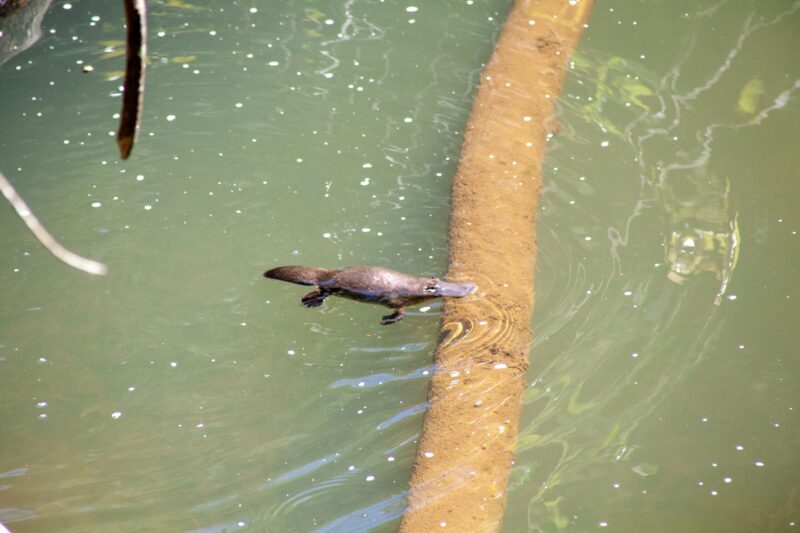
Bottom line: The platypus is an amazing animal with many talents! It can move underwater with its eyes closed thanks to its highly sensitive beak. It shines under UV light and is venomous.
Read more: Otters are cute! They’re our lifeform of the week
Read more: Seahorses are tiny, ravenous creatures: Lifeform of the week
Like what you read?
Subscribe and receive daily news delivered to your inbox.
More from
Cristina Ortiz


Venus-Jupiter conjunction 2026. Wow! Best photos here

Elephant calf reunion melts hearts in Kenya
Will Pluto become a planet again? The ongoing debate


