EarthSky’s Deborah Byrd talks about the May 30-31 Blue Moon and micromoon on this week’s livestream. Join us to find out more. You can watch in the player above or on Youtube.
May 2026 has 2 full moons. The 1st was the full Flower Moon on May 1. The 2nd will be on overnight May 30-31. It’s a Blue Moon and a micromoon – or distant full moon – the most distant full moon of 2026.
The full Blue Moon overnight on May 30-31, 2026
The coming Blue Moon – at 8:45 UTC on May 31, 2026 – is a Blue Moon and the most distant full micromoon of this year. Blue Moons aren’t blue. But micromoons – near their monthly apogees, or most distant points from Earth for the month – are small moons on our sky’s dome (although not noticeably small to the human eye).
And this May 30-31 moon is 2026’s smallest full moon. It’s about 252,360 miles (406,134 km) away, in contrast to an average moon distance of about 238,900 miles (384,472 km).
And so the May 30-31 full moon will be about 7% dimmer than an average full moon, and about 25–30% dimmer than a supermoon, or particularly close full moon.
The crest of this 2nd full moon of May falls at 8:45 UTC on May 31. That’s 3:45 a.m. CDT. So, if you live in the Americas, Europe or Africa, the moon is fullest for you during the night of May 30. But those west of the International Date Line (Australia, New Zealand and Asia) will find their fullest moon on the night of May 31.
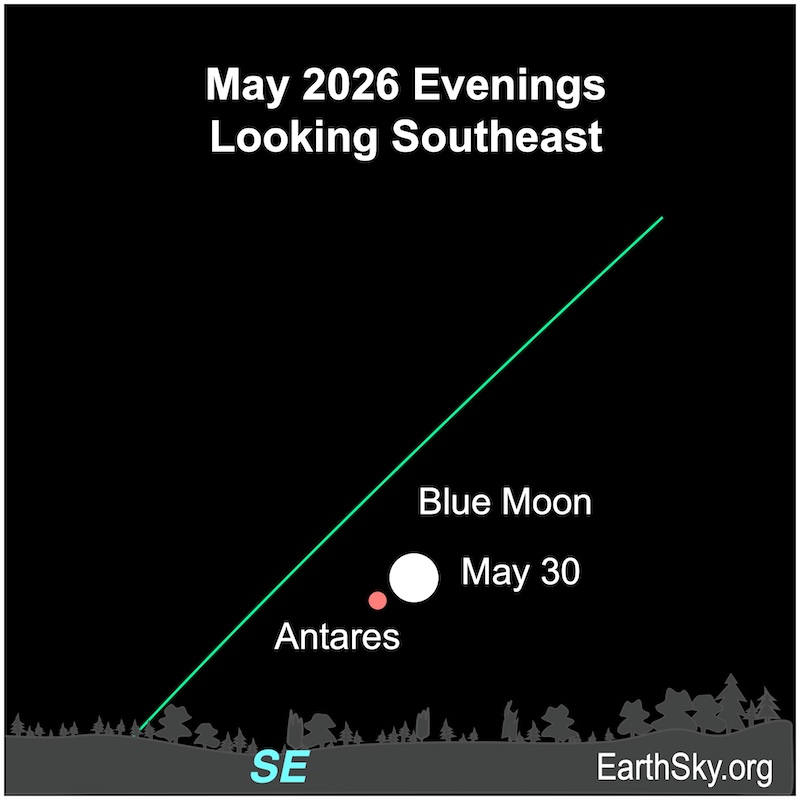
The May 30-31 Blue Moon and micromoon will be near a bright star. It’s Antares, Heart of the Scorpion in the constellation Scorpius.
What’s a Blue Moon?
So, why is the May 30-31 full moon a Blue Moon? It won’t be blue in color.
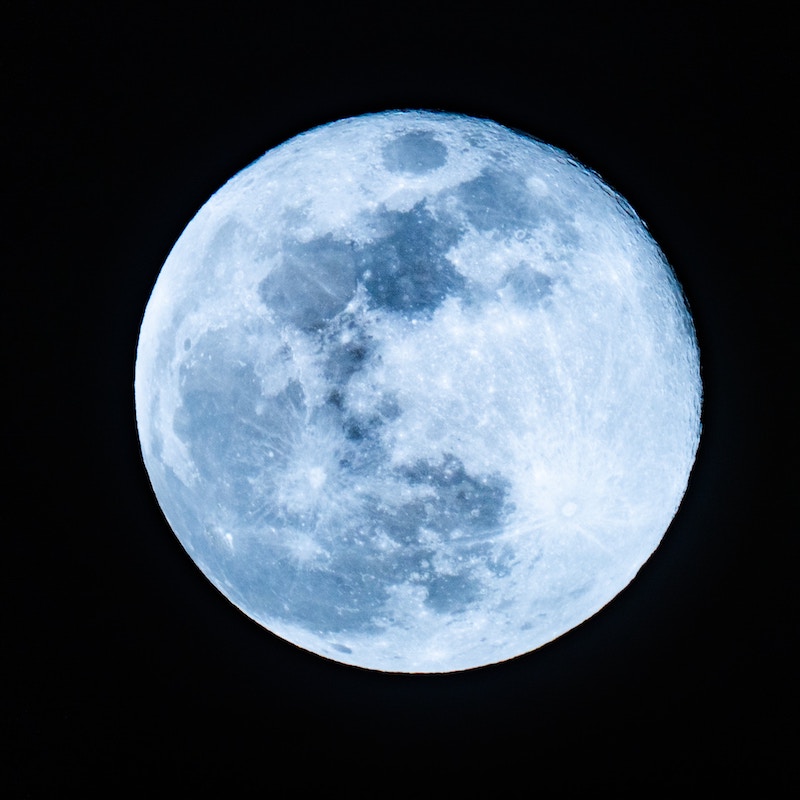
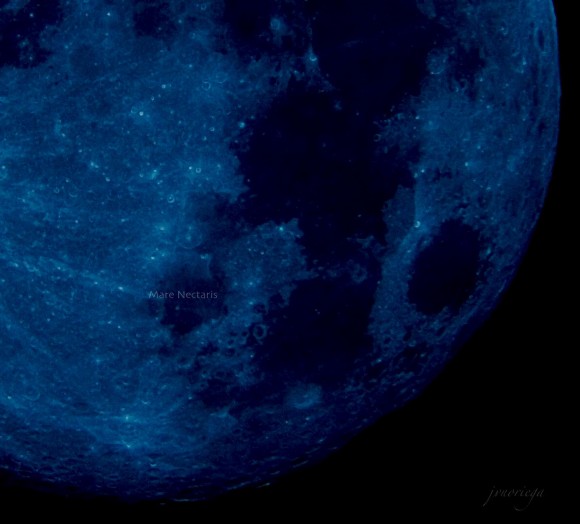
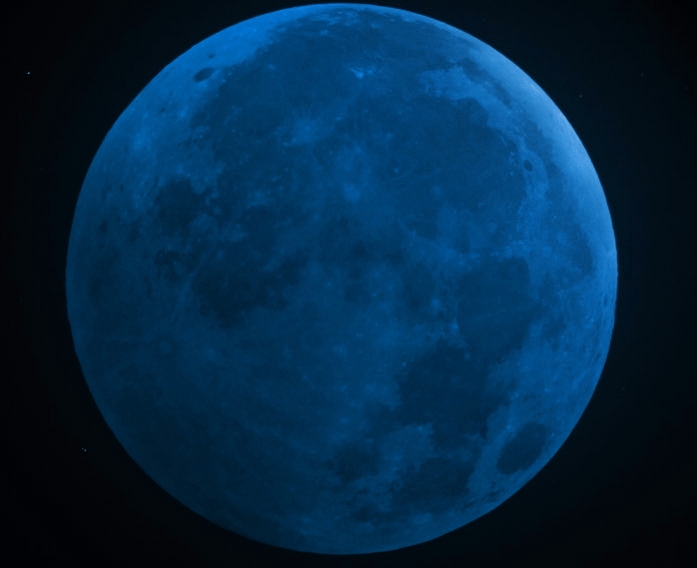
Blue-colored moons in images – such as the images on this page – are often made using special blue camera filters or in a post-processing program such as PhotoShop. Usually, but not always.
True blue-colored moons are rare, and they aren’t necessarily full. They happen when Earth’s atmosphere contains dust or smoke particles of a certain size. The particles must be slightly wider than 900 nanometers.
So you might find particles of this size in the air above you when, for example, a wildfire is raging nearby. That’s because particles of this size are very efficient at scattering red light. When these particles are present in our air, and moonlight shines through them, the moon might appear blue in color.
People reported genuinely blue-looking moons after:
- The eruption of Krakatoa in 1883.
- The Mount St. Helens eruption in 1980.
To read more about truly blue-colored moons, click here

What’s a monthly Blue Moon?
In modern times, most of us know that Blue Moons emerged from folklore. We call a full moon a Blue Moon when it’s the 2nd full moon of a single calendar month. This sort of Blue Moon happens seven times in every 19 years, or about every two to three years.
Let’s take a look at the eight calendar-month Blue Moons (dates in UTC) in the present 19-year Metonic cycle:
- March 31, 2018
- October 31, 2020
- August 31, 2023
- May 31, 2026
- December 31, 2028
- September 30, 2031
- July 31, 2034
- January 31, 2037
Also, in a year where February has no full moon at all, as in the year 2018, you can have two full moons in January and two full moons in March. Thus, during those years there are two Blue Moons in single year. The next time we have two Blue Moons in one year is 2037.
How often do monthly Blue Moons happen? Often!

What’s a seasonal Blue Moon?
By season, we’re referring to the period of time between a solstice and an equinox, or vice versa. We’re talking about winter, spring, summer, fall. Each season typically lasts three months and typically has three full moons.
The next seasonal Blue Moon will fall on May 20, 2027. It happens because June 2027’s full moon falls about two days before the June solstice, early in the season of northern summer (southern winter). And thus, there’s enough time to squeeze four full moons into the 2027 March equinox season, which will end at the June solstice on June 21, 2027.
Weirdly, it’s not the 4th of these four full moons that’ll be called a Blue Moon. It’s the 3rd. Go figure.
Full moons (based on UTC date and time) between March 2027 equinox and June 2027 solstice:
March equinox: March 20, 2027
March full moon: March 22, 2027
April full moon: April 20, 2027
May full moon: May 20, 2027
June full moon: June 18, 2027June solstice: June 21, 2027
How often do seasonal Blue Moons occur?
The phases of the moon recur on or near the same calendar dates every 19 years. That’s because 235 lunar months (235 returns to full moon) almost exactly equal 19 calendar years. Sure enough, 19 years from 2024 – in the year 2043 – the full moons will fall on June 22, July 21, August 20, and September 18.
Seasonal Blue Moons occur because there are 235 full moons but only 76 seasons (4 x 19 = 76) in this 19-year lunar cycle. If you have only three full moons in each season, then that’s a total of 228 full moons (76 x 3 = 228). Yet, there are 235 full moons in this 19-year cycle. So, these seven additional full moons (235 – 228 = 7) have to showcase seven four-full-moon seasons in this 19-year period. We list upcoming seasonal Blue Moon UTC dates – following the August 19, 2024, seasonal Blue Moon – below:
May 20, 2027
August 24, 2029
August 21, 2032
May 22, 2035
May 18, 2038
August 22, 2040
August 20, 2043
How often do seasonal Blue Moons happen? Like monthly Blue Moons, they happen a lot.
A seasonal and a monthly Blue Moon in a single year?
Very rarely, a seasonal Blue Moon (3rd of four full moons in one season) and a monthly Blue Moon (2nd of two full moons in one calendar month) can occur in the same calendar year. For this to happen, you need 13 full moons between successive December solstices for a seasonal Blue Moon and, generally, 13 full moons in one calendar year for a monthly Blue Moon.
This will next happen in the year 2048, when a monthly Blue Moon falls on January 31, and a seasonal Blue Moon on August 23.
Then 19 years later, in the year 2067, there will be a monthly Blue Moon on March 30, and a seasonal Blue Moon on November 20. In this instance, there are 13 full moons between successive December solstices, but only 12 full moons in one calendar year and no February 2067 full moon.
Why call them Blue Moons?
The idea of a Blue Moon as the 2nd full moon in a month is more recent – more modern – than the idea of a Blue Moon as the 3rd of four full moons in a season. It stemmed from the March 1946 issue of Sky and Telescope magazine. The magazine published an article called “Once in a Blue Moon” by James Hugh Pruett. Pruett was referring to the 1937 Maine Farmer’s Almanac, which defined Blue Moons as the 3rd of four full moons in a season. But he inadvertently simplified the definition. He wrote:
Seven times in 19 years there were – and still are – 13 full moons in a year. This gives 11 months with one full moon each and one with two. This second in a month, so I interpret it, was called Blue Moon.
Had James Hugh Pruett looked at the actual date of the 1937 Blue Moon, he would have found that it had occurred August 21, 1937. Also, there were only 12 full moons in 1937. You generally need 13 full moons in one calendar year to have two full moons in one calendar month.
However, that fortuitous oversight gave birth to a new and perfectly understandable definition for Blue Moon.
Blue Moons as modern folklore
The notion of a Blue Moon as the 2nd full moon of a calendar month was buried for decades. Then, in the late 1970s, EarthSky’s Deborah Byrd happened upon a copy of the old 1946 issue of Sky and Telescope in the stacks of the Peridier Library at the University of Texas Astronomy Department. Afterward, she began using the term Blue Moon to describe the second full moon in a calendar month on the radio series StarDate, which she wrote and produced.
Later, this definition of Blue Moon was also popularized by a book for children by Margot McLoone-Basta, called The Kids’ World Almanac of Records and Facts, published in New York by World Almanac Publications in 1985. The second-full-moon-in-a-month definition was also used in the board game Trivial Pursuit.
Today, it has become part of modern folklore. As the folklorist Philip Hiscock wrote in his comprehensive article Once in a Blue Moon:
‘Old folklore’ it is not, but real folklore it is.
Bottom line: The full moon overnight on May 30-31, 2026, is a Blue Moon. What is a Blue Moon? The 2nd of two full moons in a calendar month? Or the 3rd of four full moons in a single season? The answer is … both!
Phases of the moon: 2001 to 2100
Like what you read?
Subscribe and receive daily news delivered to your inbox.
More from
Editors of EarthSky


Comet Halley is parent of 2 meteor showers

Inferior conjunction — Venus! October 23-24, 2026
Mercury after sunset and great for Southern Hemisphere!
Meteor shower guide 2026: Up next … the Orionids