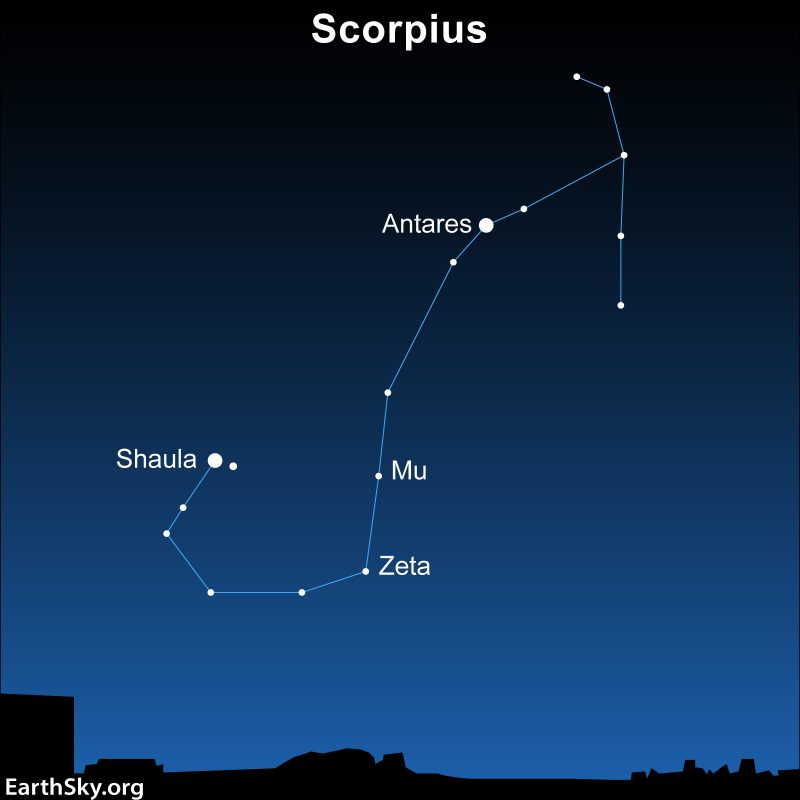
Antares is an eye-catching star. It shines with a distinctive bright red sparkle on northern summer evenings, while in the Southern Hemisphere it’s a red beacon in winter evening skies. This star, also known as Alpha Scorpii, lies about 550 light-years away. It’s the brightest star in the zodiacal constellation Scorpius the Scorpion, which has figured prominently in the skylore of ancient cultures. Its nickname is the Scorpion’s Heart.
Today, we know that Antares is a massive star – a red supergiant – in the final stages of its life.

How to see Antares from the Northern Hemisphere
For all of us on Earth, the midnight culmination of Antares – when it’s highest in the sky in the middle of the night – is in mid-June. It is highest in the sky at about dawn in late March and at about evening twilight in late July.
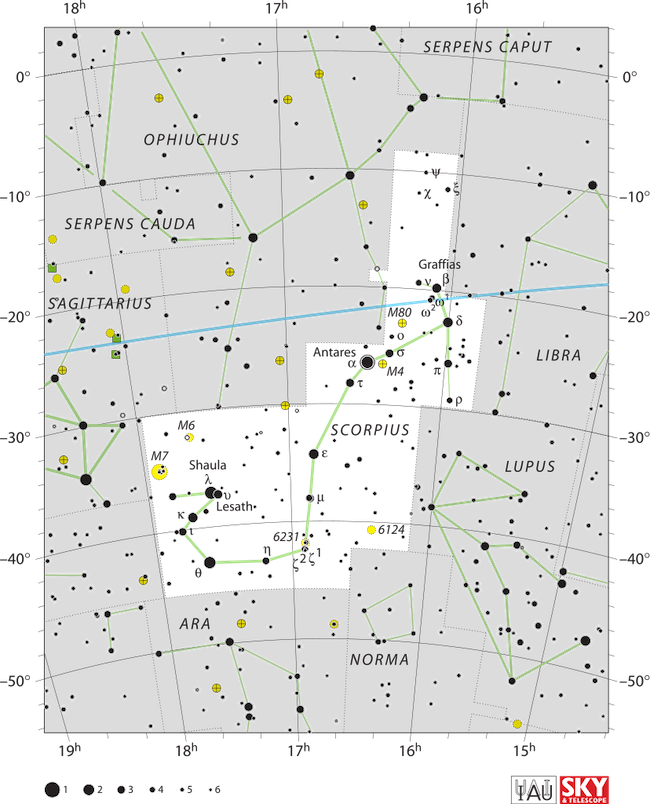
From the Northern Hemisphere, look southward in the early evening from late spring to early fall to find the fishhook pattern of Scorpius the Scorpion, with ruby Antares at its heart. With the eye alone, and with binoculars, you should notice its reddish color.
Also, if you have binoculars and a dark sky, scan just to the right of Antares. You should see a little globular star cluster, M4.
Antares is the 15th-brightest star in the sky. From our northerly latitudes, we see it arc across the south. Because we’re sometimes looking at it through a greater thickness of Earth’s atmosphere near the horizon, we see Antares twinkle fiercely. In the Northern Hemisphere, anyone south of 63 degrees north latitude can – at one time or another – see Antares.
How to see Antares from the Southern Hemisphere
Conversely, from the Southern Hemisphere, Antares appears higher in the sky. Your chance of seeing this star on any given night increases as you go farther southward on Earth’s globe. So, if you traveled to about 63 degrees south latitude, you’d find that Antares is circumpolar. That means that, from Earth’s southernmost regions, Antares never sets and is visible every night of the year.
The Heart of the Scorpion is a red supergiant
Antares holds the stellar classification of an M1 red supergiant star.
The M1 designation means that Antares is reddish in color and much cooler than many other stars. Its surface temperature is about 6,100 degrees F (3,400 degrees C). That’s in contrast to our sun’s surface temperature of about 10,000 degrees F (5,500 degrees C).
So, Antares is relatively cool, and its surface temperature is relatively low. Yet the star appears very bright to us, shining at a variable magnitude of between 0.6 and 1.6. That’s because Antares is a truly enormous star. Its surface area – the surface from which light can escape this star – is gigantic. That’s made Antares more than 10,000 times brighter than our sun. Plus, it is about 700 times the sun’s diameter!
And that’s just in visible light. When you also consider all the various wavelengths of electromagnetic radiation, Antares pumps out about 75,900 times the energy of our sun.

For Antares, the end is near
Like all M-type giants and supergiants, Antares is close to the end of its lifetime. In fact, someday soon (astronomically speaking), it will effectively run out of fuel and collapse. The resulting rapid collapse of its enormous mass – some 11-14 times the mass of our sun – will cause an immense supernova explosion. This will ultimately leave a tiny neutron star or possibly a black hole. This explosion – which could be tomorrow or millions of years from now – will be spectacular as seen from Earth. Thankfully, we’re far enough away that there is no danger to our planet.
In the meantime, astronomers love to explore huge Antares. For example, in 2017, the European Southern Observatory released a detailed image, taken in infrared wavelengths, of features on Antares’ surface. In addition, they also found that there was a lot of turbulence in the star’s atmosphere and that the star was expelling gases farther away than they expected. See the video below.
Just how large is Antares?
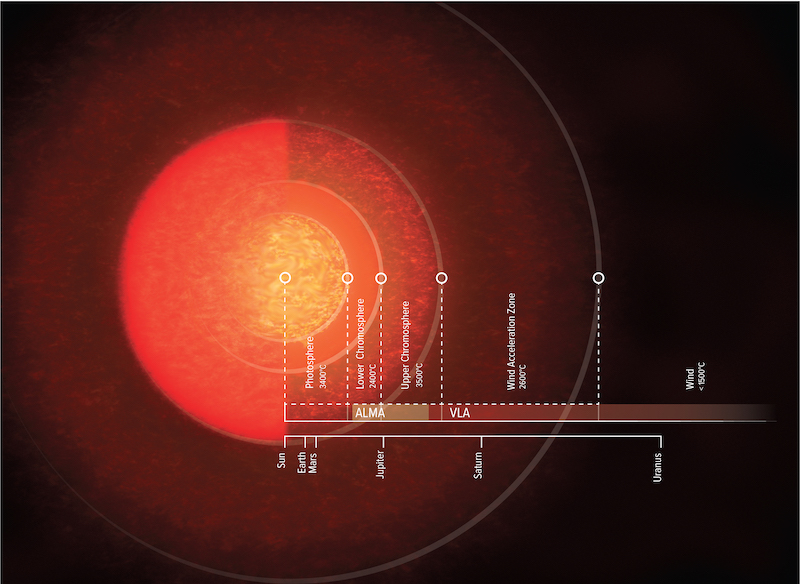
Antares is a truly enormous star with between 680 to 800 times the sun’s radius. So, if by some bit of magic, we could substitute Antares for our sun, Antares’ surface would extend well past the orbit of Mars and into the asteroid belt.
Recently, astronomers discovered more details about Antares’ outer surface. In 2020, a study of data from radio telescopes showed that Antares’s chromosphere (that’s the layer above the star’s surface) extended out by 2.5 times the star’s radius, far more than previously thought. Conversely, in comparison, our sun’s chromosphere is only 1/200th of its radius.
They also saw that its companion star, Antares B, was lighting up some of the gaseous material that Antares was ejecting.
Antares and Antares B
Antares isn’t alone, either. It has a companion, Antares B. However, it’s hard to see Antares B next to its much brighter companion.
The companion is a blue-white main sequence star with a magnitude of just 5.5. This is near the edge of what you can see with the unaided eye. Antares itself varies in brightness, and its visual magnitude ranges from 0.6 to 1.6. Antares B is also a big star, bigger than our sun. It’s about 7 times the sun’s mass and 5 times the sun’s size. But Antares B is no match for the size of mighty Antares.
Amateur astronomers can spot Antares B on a steady night with a telescope of at least 8-inch (20 cm) aperture and 200 power. The secondary star is about 2.5 arcseconds due west of Antares.

Antares in history and skylore
Both the Arabic and Latin names for the star Antares mean Heart of the Scorpion. If you see this constellation in the sky, you’ll find that Antares does indeed seem to reside at the Scorpion’s Heart.
But the name Antares is Greek for rival of Ares, meaning rival of Mars or the anti-Mars. That’s because it has a very similar color to Mars, and it resides near the ecliptic, as Mars and all the planets do. Every couple of years Mars passes near Antares, as if taunting the star. And for a few months every couple of years, Mars is much brighter than Antares. Mars will pass close to Antares next in late October 2027.
The most well-known story of Scorpius, home to Antares, is that the Earth goddess, Gaia, sent him to sting arrogant Orion the Hunter, who had claimed his intent to kill all animals on the planet. Scorpius killed Orion, and now both reside in the sky on opposite sides of the heavens.
In Polynesia, Scorpius represents a fishhook, with some stories describing it as the magic fishhook used by the demigod Maui to pull up land from the ocean floor that became the Hawaiian Islands. According to the University of Hawaii’s Institute for Astronomy, the Hawaiian name for Antares, Lehua-Kona, seems to have little to do with the constellation. It means “southern lehua blossom.”

Antares’ position is RA:16h 29m 24s, dec: -26° 25′ 55″.
Bottom line: Antares is a brilliant ruby red star in Northern Hemisphere summer and Southern Hemisphere winter. It’s an enormous red supergiant star, whose constellation – Scorpius the Scorpion – has a rich history in skylore.
Scorpius the Scorpion and its legendary stinger
Read more: The Scorpion’s Crown and its stellar neighborhood
Like what you read?
Subscribe and receive daily news delivered to your inbox.
More from
Larry Sessions


Why can’t I find the Big Dipper in September?

Fomalhaut is the Loneliest Star once again
Summer Triangle star: Altair is variable and spins fast!
Summer Triangle star Deneb is distant and luminous