



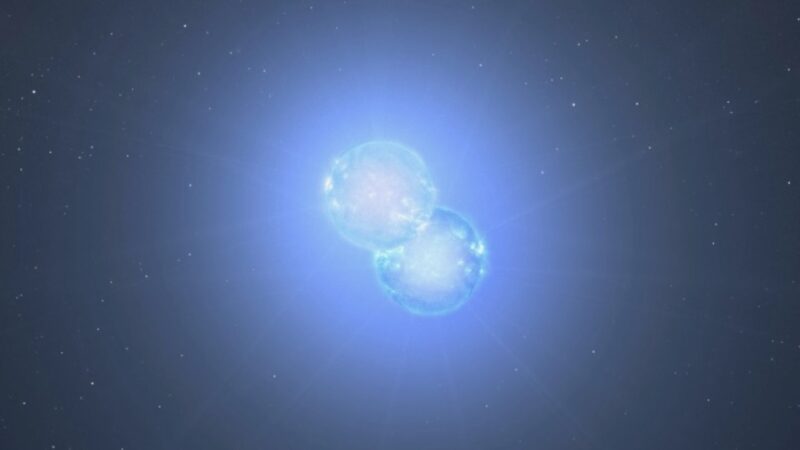
Spica is a close double star
The star Spica – aka Alpha Virginis – is the brightest star in the constellation Virgo the Maiden. From our distance of about 250 light-years away, Spica appears as a lone blue-white star. But the single point of light we see as Spica is really at least two stars.
Both the stars that we know make up Spica are larger and hotter than our sun. And they’re separated by only 11 million miles (less than 18 million km). That’s not much more than 10% of the distance between Earth and our sun (93 million miles or 150 million km). They orbit their common center of gravity in only four days.
Because they are so close, the two stars in the Spica system are individually indistinguishable from a single point of light, even with a telescope. Only the analysis of its light with a spectroscope – an instrument that splits light into its component colors – revealed the dual nature of this star. So Spica is considered a spectroscopic binary star.
Spica shines at magnitude 1.04, making it the brightest light in Virgo. It’s the 15th-brightest star visible from anywhere on Earth. It’s virtually the same brightness as Antares in the constellation Scorpius the Scorpion, so sometimes Antares is listed as the 15th and Spica as the 16th brightest.
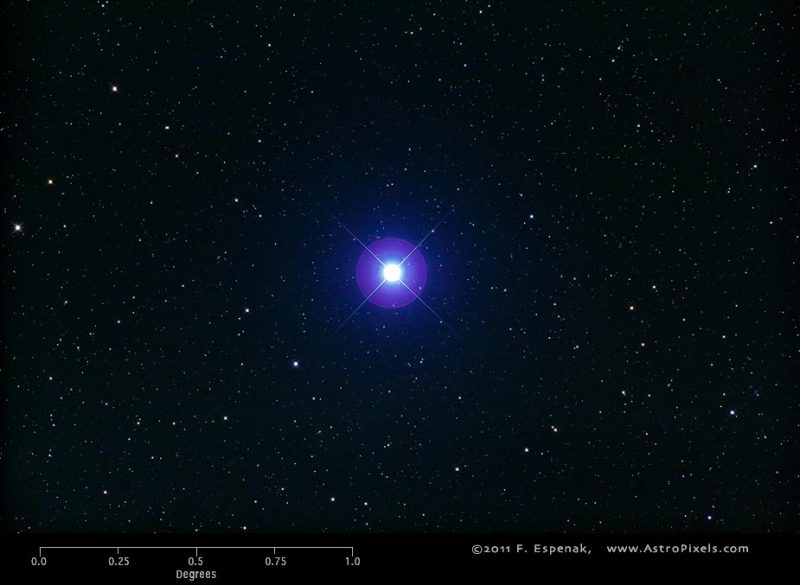
Hot, hot, hot
Spica’s two stars are so close, and they orbit so quickly around each other, that their mutual gravity distorts each star into an egg shape. It’s thought that the pointed ends of these egg-shaped stars face each other as they whirl around.
The pair of stars are both dwarf stars, brightening as they near the end of their lifetimes.
Spica is one of the hottest 1st-magnitude star systems. The hottest of the pair is about 40,000 degrees F or 22,000 C. That’s blistering in contrast to our sun’s 10,000 F or 5,500 C. This star might someday explode as a supernova.
The light from Spica’s two stars, taken together, is on average more than 12,100 times brighter than our sun’s light. Their estimated diameters are 7.8 and 4 times our sun’s diameter.
Spica is one of several bright stars that the moon occasionally passes in front of. And that gives astronomers a great opportunity to study the star system closely. By observing precisely how Spica’s light is extinguished when the moon passes in front of it, some astronomers think that it may not just be a binary star. Instead, they think that there may be as many as three other stars in the system. So Spica might not be a double star, but a quintuple star!
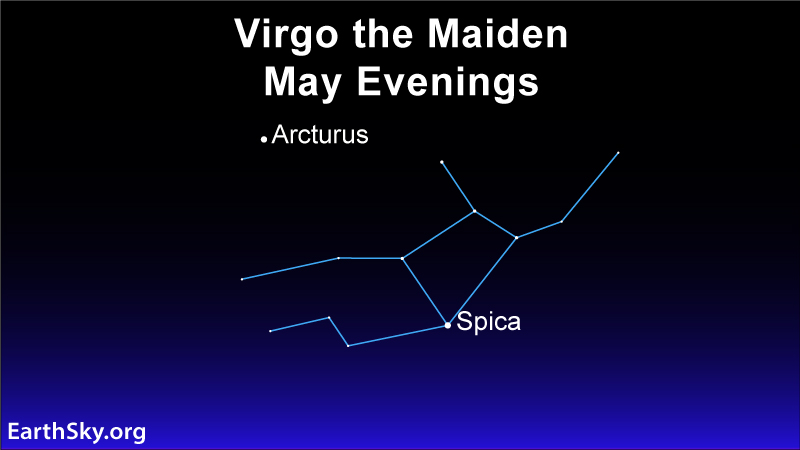
How to find Spica from the Northern Hemisphere
The best views of Spica come from spring to late summer, when this star arcs across the southern sky in the evening. From the Northern Hemisphere, there’s a foolproof way to find Spica, using the Big Dipper as a guide. Scouts and stargazers remember this trick with the saying: Follow the arc to Arcturus, and speed on (or drive a spike) to Spica.
First, look for the Big Dipper in the northern sky. It’s highest in the evening sky in the northern spring and summer. Notice that the Big Dipper has a bowl and a long, curved handle.
Then follow the arc of the Dipper’s handle outward, away from the Dipper’s bowl. The first bright star you come to is orange Arcturus.
Then speed on (or drive a spike) along this curving path. And the next bright star you come to is Spica.
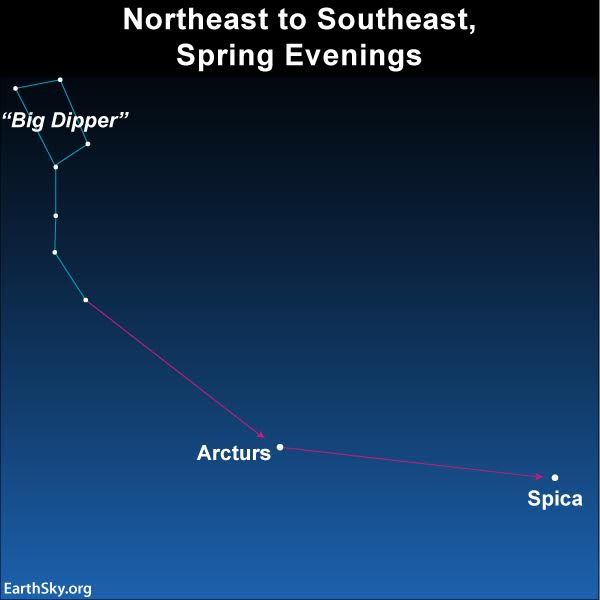
How to see Spica from the Southern Hemisphere
Via Daniel Gaussen, Founder & Guide – Stargaze Mackenzie – New Zealand
For Southern Hemisphere observers, Virgo is one of the most prominent constellations of the autumn evening sky during May and June. For Southern Hemisphere stargazers, Spica arcs across the northern sky. Spica’s constellation, Virgo, is a member of the zodiac. So it follows the sun’s path across our sky. That’s why Spica crosses the meridian high above your horizon, when viewed from the Southern Hemisphere.
For us, the constellation Virgo appears upside-down in contrast to Northern Hemisphere star charts, a reminder that people on the northern and southern halves of Earth see the celestial sphere as reversed. Despite this different orientation, the bright blue-white star Spica remains easy to identify as Virgo’s brightest star.
Try looking for Spica using two other bright stars – Arcturus and Regulus – as guides. Spica, Arcturus and Regulus form a noticeable triangle. In the Northern Hemisphere, these three are called the Spring Triangle. For us, these three bright stars dominate our northern evening sky in autumn, with Spica reaching highest of the three.
Look for the distinctive shape of the constellation Virgo the Maiden extending below Spica. The constellation forms a large, somewhat rectangular pattern of stars, although these stars are much fainter than Virgo’s brightest star. You’ll need a dark sky to see them!
History and mythology of Spica
The name Spica is from the Latin word for “ear” (of grain). The general connotation is that Spica refers to an “ear of wheat.” Indeed, the star and the constellation Virgo itself were sometimes associated with the Greek goddess of the harvest, Demeter.
There are many names and stories for Spica’s constellation – Virgo – in mythology, and by association with Spica as well. Fewer stories refer to Spica independently. Many classical references refer to Virgo’s stars as a goddess or with some association with wheat or the harvest, since the sun passes through Virgo in the fall. In Greek and Roman mythology she typically was Astraea, the very personification of Justice; or Persephone, daughter of Demeter. In Egypt, Virgo was identified with Isis, and Spica was considered her lute bearer. In ancient China, Spica was a special star of spring known as the Horn.
One Arabic name was Azimech, derived from words meaning Defenseless One or Solitary One. This title may be in reference to Spica’s solitary status with no other bright stars nearby. But Spica is not the most solitary star. That honor goes to Fomalhaut, sometimes called the Autumn Star.
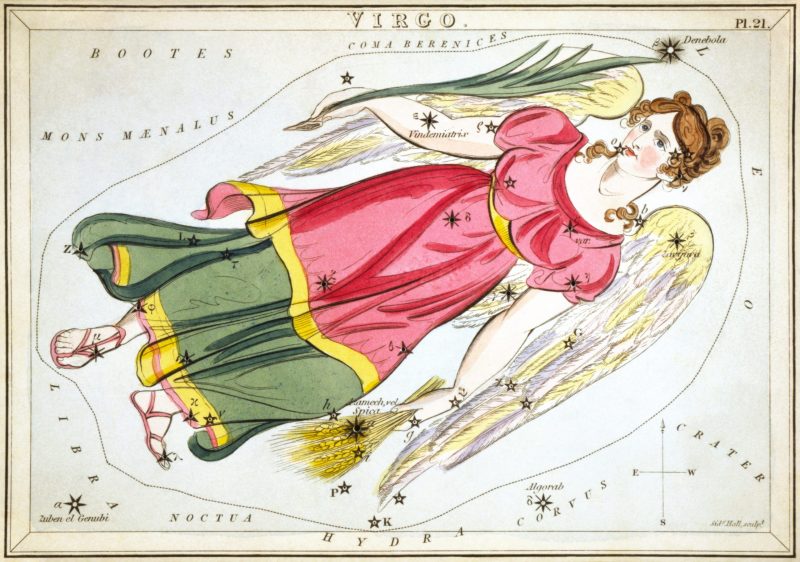
Bottom line: Spica is the brightest star in Virgo. Spica is at least two stars orbiting extremely close together, distorting each other into egg shapes.
Read more: Virgo the Maiden represents a harvest goddess
Read more: Castor – the twin star in Gemini – is 6 stars in one
Like what you read?
Subscribe and receive daily news delivered to your inbox.
More from
Deborah Byrd


Orionid meteor shower 2026: All you need to know

Visible planets and night sky guide for October
See brightest star, Sirius, in your morning sky
Cassiopeia the Queen is overhead on autumn evenings



