EarthSky’s Marcy Curran introduces you to the Pleiades, or 7 Sisters, in this video.
Come to know the legendary Pleiades star cluster
The Pleiades star cluster is also famously known as the Seven Sisters. Or, to some, it’s known as Messier 45 (M45) on the list of Messier objects. The Pleiades is visible from almost every part of the globe. It’s seen from as far north as the North Pole and farther south than the southernmost tip of South America. It looks like a tiny, misty dipper of stars.
In fact, many ancient cultures had myths and stories associated with the Pleiades. In Greek mythology, the Pleiades were the seven daughters of Atlas, a Titan who held up the sky, and the oceanid Pleione, protectress of sailing. The sisters were Maia, Electra, Alcyone, Taygete, Asterope, Celaeno and Merope. Also, the Pleiades were sometimes said to be nymphs in the train of Artemis. They were half-sisters of the seven Hyades. The Hyades pattern is another star cluster near the Pleiades stars.
According to a Polynesian legend, the Pleiades was once a single star: the brightest in the sky. The Polynesian god Tane disliked this star bragging about its beauty. So the god smashed the star into pieces, creating the Pleiades star cluster.
Pleiades and Halloween
The modern-day festival of Halloween originates from an old Druid rite that coincided with the midnight culmination of the Pleiades cluster. People believed the veil dividing the living from the dead was at its thinnest when the Pleiades culminates – reaches its highest point in the sky – at midnight.
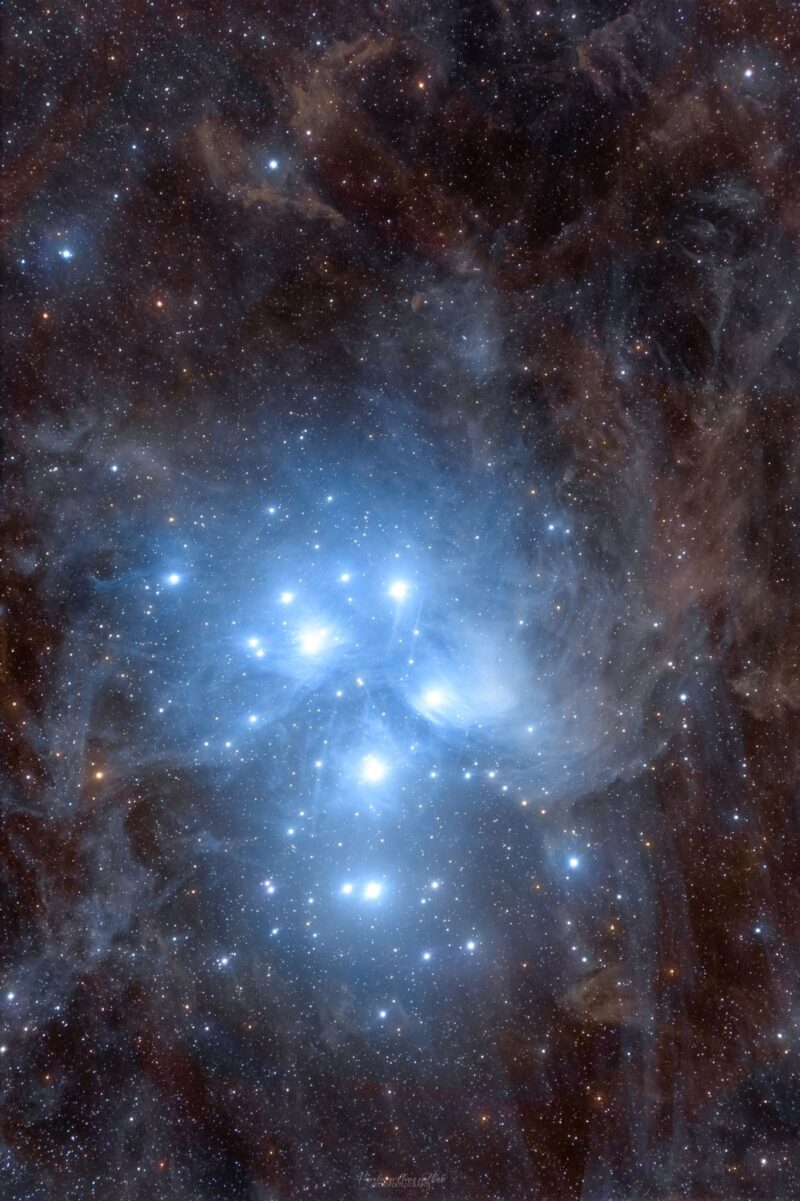
Sibling stars traveling through space together
In both myth and science, the Pleiades are sibling stars. In fact, they are an open star cluster. Modern astronomers say the stars were born from the same cloud of gas and dust some 100 million years ago. This gravitationally bound cluster of several hundred stars looms some 440 light-years distant. Also, these sibling stars drift through space together at about 25 miles per second (40 km per second). Many of these stars shine hundreds of times more brightly than our sun.
And recently astronomers discovered that the Pleiades star cluster has more than 3,000 sibling stars that originated from the same giant molecular cloud.
Read more: Open star clusters are loose groups of stars

How to find the Pleiades
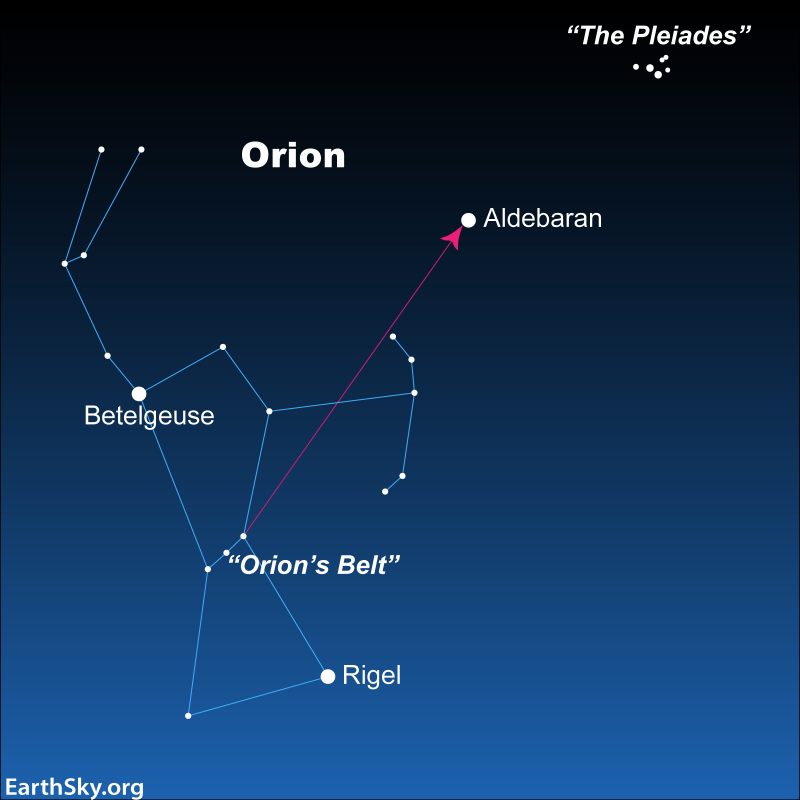
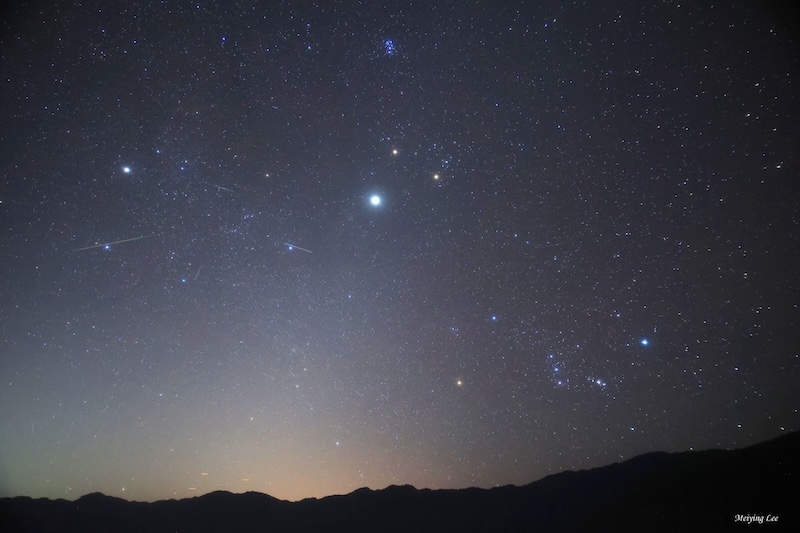
If you’re familiar with the famous constellation Orion the Hunter, it can help you confirm you’ve found the Pleiades. See the three stars in a row in Orion? That’s Orion’s Belt. Now draw a line through these stars to the V-shaped pattern of stars with a bright star in its midst. The V-shaped pattern is the Face of Taurus the Bull. The bright star in the V – called Aldebaran – depicts the Bull’s Eye. Then, when you go a bit past Aldebaran, you’ll see the Pleiades cluster. It marks the Bull’s Shoulder.
In our Northern Hemisphere skies, the Pleiades cluster is associated with the coming winter season. It’s easy to imagine this misty patch of icy-blue suns as hoarfrost clinging to the dome of night. So frosty November is the month of the Pleiades, because it’s at this time that the Pleiades shine from dusk until dawn. But you can see the Pleiades cluster in the evening sky well into April.
The Pleiades and Aldebaran
The star name Aldebaran comes from an Arabic word for follower. It’s thought to be a reference to this star’s forever chasing the Pleiades across the heavens. As a general rule, the Pleiades cluster rises into the eastern sky before Aldebaran rises, and sets in the west before Aldebaran sets.
The only exception to this rule happens at far southern latitudes. For example, at South America’s Tierra del Fuego, the Pleiades rise a short while after Aldebaran rises.
Legend of the Lost Sister
Most people see six, not seven, Pleiades stars in a dark country sky.
However, the story about the lost 7th Pleiad appears universal. The astronomer Robert Burnham Jr. found the lost Pleiad myth prevalent in the star lore of European, African, Asian, Indonesian, Native American and Aboriginal Australian populations.
Moreover, Burnham suggested that the “lost Pleiad” may have basis in fact. Modern astronomy has found that the 7th-brightest Pleiades star – Pleione – is a complicated shell star that goes through numerous permutations. Naturally, these changes can cause this star to vary in brightness.
Plus, people with exceptional eyesight have been known to see many more stars in the cluster. Claims go up as high as 20 stars. Agnes Clerke, an astronomer and writer in the late 1800s, reported that Michael Maestlin, the mentor of Johannes Kepler, mapped out 11 Pleiades stars before the invention of the telescope.
To see more than six or seven Pleiades stars, you must have very good eyesight (or a pair of binoculars). And you must be willing to spend time under a dark, moonless sky. Stephen O’Meara, a dark-sky connoisseur, claims that eyes dark-adapted for 30 minutes are six times more sensitive to light than eyes dark-adapted for 15 minutes. But the surest way to see additional Pleiades stars is to look at this cluster using some optical aid.
The Pleiades photo gallery

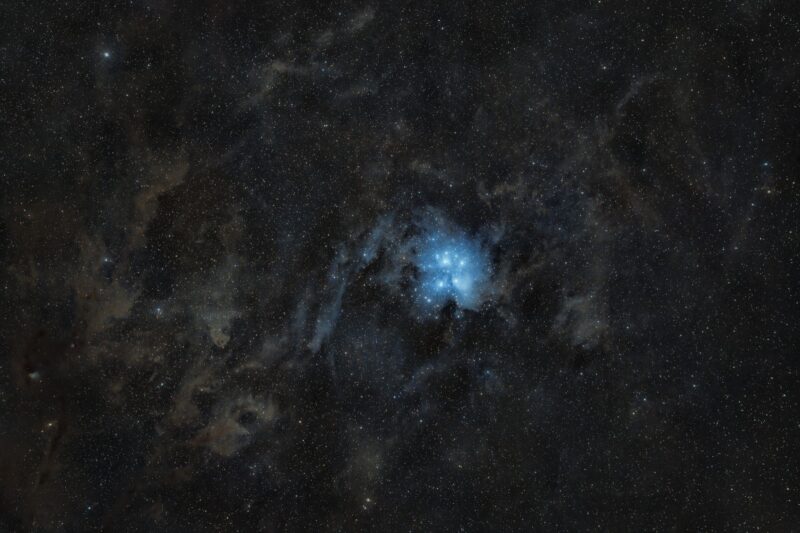
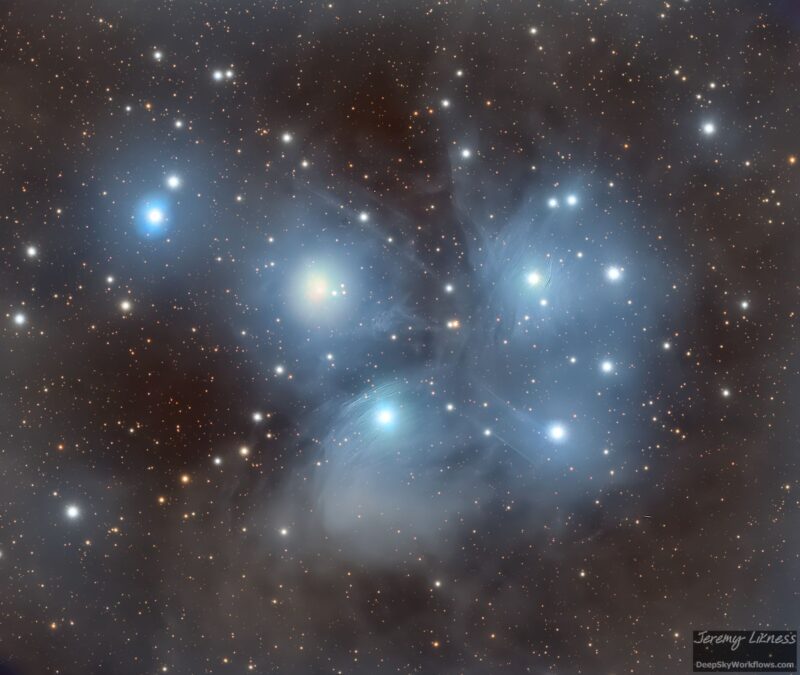
Bottom line: The Pleiades star cluster – aka the Seven Sisters or M45 – is visible from almost every part of the globe. It looks like a tiny, misty dipper of stars.
Like what you read?
Subscribe and receive daily news delivered to your inbox.
More from
Bruce McClure


Alpha Cephei, or Alderamin, is a fast-spinning star

The Andromeda Galaxy: All you need to know
Are day and night equal on the equinox? Not exactly
See the year’s fastest sunsets and sunrises around equinoxes